


The Good
Ten thousand dollars is real money.
It isn’t a slogan.
It isn’t another appreciation luncheon, paper certificate or acrylic trophy.
For a paraprofessional earning barely enough to survive in New York City, it’s rent. Childcare. Groceries. Gas. A car repair. A chance to breathe, even if only for a moment.
The people who fought for this deserve credit.
Not the highly paid politicians and union staffers standing behind podiums taking victory-lap selfies.
Credit belongs to the hardworking paraprofessionals who were told, “Not now.”
The members who asked for a comprehensive bargaining plan and were handed a paraprofessional chapter handbook instead.
The people who voted for a change in direction.
The people in our classrooms who made neglect politically expensive.
Whether this bill ultimately survives or not, the movement accomplished something larger than a one-time payment.
It forced our union and New York City to confront a reality that had been ignored for decades.
For years, paraprofessionals were told their concerns would have to wait.
Wait until the next contract.
Wait until the next budget.
Wait until the next bargaining cycle.
This week proved that organized members don’t always have to wait forever.
Pressure works.
Elections matter.
Organizing matters.
And the people who refused to accept that paraprofessionals should remain the forgotten workforce inside our union changed the conversation—not just inside the UFT, but across New York City.
Paraprofessionals can no longer be treated as an afterthought.
For that, every person who organized, spoke up, voted, attended meetings, challenged leadership and refused to let the issue die deserves recognition.
Whether the Respect Check ultimately survives politically or legally, the movement has already accomplished something that cannot be repealed.
It forced New York City to finally acknowledge that the people who help educate and care for our most vulnerable students deserve far more than appreciation.
They deserve a living wage. Period. Full stop.
The Bad
For roughly sixteen years under Michael Mulgrew’s leadership, there was no fundamental effort to restructure paraprofessional salaries. Aside from modest improvements to longevity raises in the 2018 contract, paraprofessional pay remained largely governed by the same pattern bargaining that had left many struggling to survive.
Then came the last contract.
The UFT had roughly $450 million in recurring, non-pensionable retention money available.
Leadership had choices.
It could have directed more of that money—or even all of it—toward the city’s lowest-paid title and begun closing the wage gap at the bargaining table.
It didn’t.
The money was spread broadly and equally across all titles.
The people with the least remained with the least.
That decision continues to shape this debate.
Today, much of the union’s messaging presents a false choice between this legislation or waiting until the next contract.
But that presents an incomplete picture. And a false dilemma.
Collective bargaining doesn’t operate on a fixed calendar.
The UFT, as the certified bargaining representative, can reopen negotiations with the city at any time if both parties agree.
In fact, the union did exactly that this year.
While the current teachers’ contract remains in effect, the UFT negotiated a side agreement creating salary differentials of up to $9,500 for eligible teachers assigned to schools that remain above the state’s class-size limits because compliance with the law has been delayed for two more years.
That agreement demonstrates that targeted compensation issues can be negotiated before a contract expires.
Would the city have agreed to reopen negotiations over paraprofessional salaries?
No one can answer that with certainty.
But bargaining remained another available path. And the services they provide are mandated by law.
Another question deserves attention.
The UFT leadership appears to have invested significant political capital in City Council Speaker Julie Menin, who became the public face of this legislation. Campaign finance disclosures showed that an independent expenditure committee aligned with UFT leadership spent more than $210,000 supporting Menin’s City Council campaign, while the union later promoted her as the “Champion of the Paraprofessional Respect Check.”
Menin received the second highest amount of UFT political donation dollars among all other candidates in this past election cycle even as she faced no legitimate challenge for her seat. She was second only to a UFT operative named Dermot Smyth, who lost his City Council bid.

None of this proves that legislative decisions were bought or improperly influenced.
Independent expenditures and political endorsements are legal and commonplace.
But it illustrates something larger.
When a union chooses to pursue compensation primarily through legislation rather than collective bargaining, it necessarily becomes more dependent on political relationships.
Those relationships can change.
Menin has been mentioned in political circles as a potential mayoral candidate who could someday challenge Mayor Zohran Mamdani.
Whether that happens or not, political alliances rarely remain permanent.
Elections change.
Speakers change.
Mayors change.
Budget priorities change.
Collective bargaining, by contrast, isn’t dependent on who occupies City Hall.
It remains available regardless of which politician holds office.
That distinction matters.
Then came the victory laps.
Within hours of the Council vote, a senior UFT staff member who has never taught in a classroom, and makes hundreds of thousands of dollars, described Michael Mulgrew as a “generational leader.”
That’s quite a remarkable claim.
Because for multiple generations of paraprofessionals, the story has largely been the opposite.
Contract after contract. Pattern raise after pattern raise.
Paraprofessionals fell farther behind inside a union that proudly calls itself “A Union of Professionals.”
If this is the defining achievement of a generation, then it’s fair to ask:
Why did it take sixteen years? Twenty years? Forty years?
Why wasn’t this fight waged years ago, when paraprofessional pay was already in crisis?
History doesn’t remember who announced the building of a bridge.
It remembers who finished building it.
The Ugly
The promised fix has kept shrinking.
Members were first promised a permanent Para Pay Index—a non-pensionable annual payment of more than $10,000 based on a formula designed to grow over time and begin closing the wage gap.
That became a non-pensionable annual workforce stabilization payment.
Then it became what passed this week: four legislatively authorized payments tied to a single school year.
Now union leadership tells members that if the money isn’t incorporated into a future contract, the City Council can simply reauthorize it.
Maybe. If it can.
But that isn’t what this law actually says.
This legislation contains no internal mechanism for annual reauthorization.
Instead, it authorizes payments for one defined school year and then repeals itself in 2027.
If paraprofessionals are to receive another year’s payments, the entire legislative process begins again.
A new bill.
New sponsors.
Committee hearings.
Another Council vote.
Another mayoral decision.
Potentially another legal challenge.
That isn’t extending this law.
That’s passing an entirely new one.
Which raises another question.
If the proposal changed this dramatically—from a permanent formula, to annual stabilization payments, to a one-year program—why weren’t members kept informed as those changes occurred?
Why wasn’t the rationale explained?
Why did members have to discover major revisions by reading amended legislation instead of hearing them from their own leadership?
Good leadership doesn’t simply announce victories.
It explains compromises.
Especially when the promise changes.
Then comes the legal question.
The Taylor Law has long treated wages as a mandatory subject of collective bargaining.
Whether this legislation ultimately survives judicial review remains an open question.
Maybe the courts uphold it.
Maybe they don’t.
But every municipal union in New York City is now watching.
Recent lobbying disclosures show District Council 37 (DC37) actively lobbied on Intro. 692. Those filings don’t reveal whether the union supported or opposed the legislation, but they confirm that the city’s largest municipal union recognized the significance of what was happening.
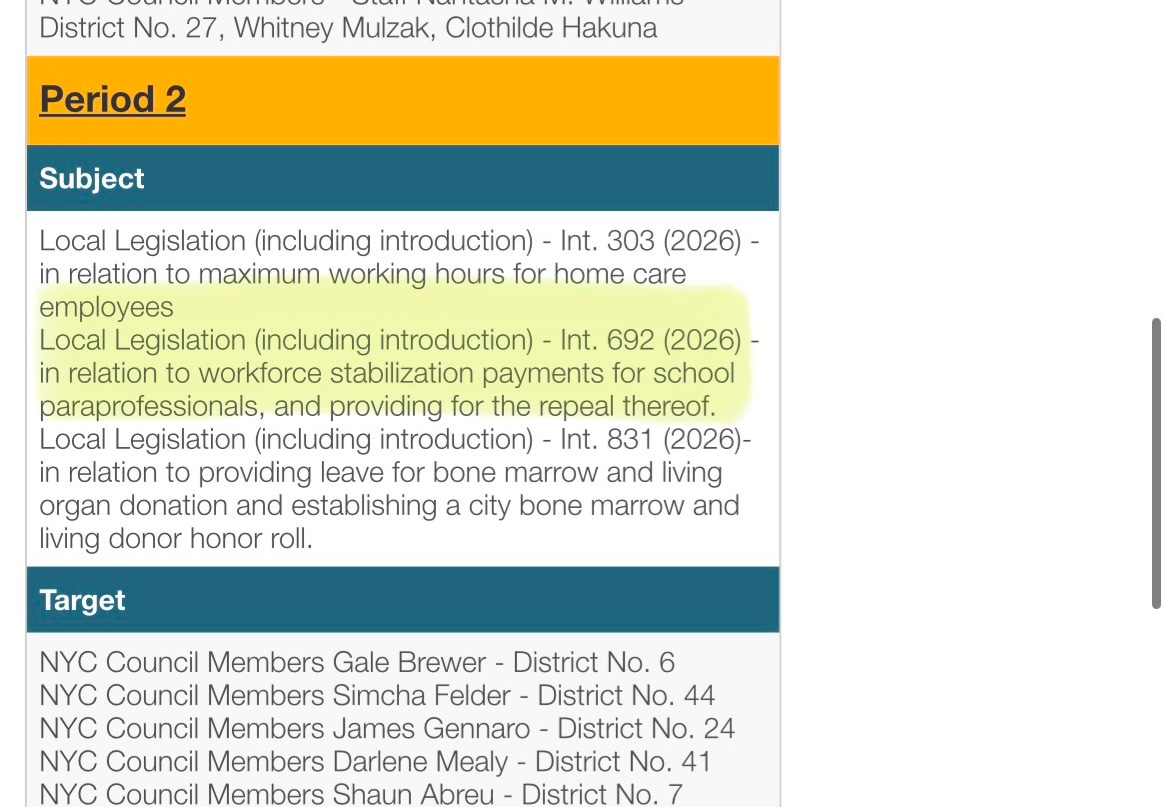
The ripple effects are already beginning.
Council Member Joann Ariola has announced legislation proposing $20,000 workforce stabilization payments for FDNY EMTs and $25,000 payments for FDNY paramedics, arguing they face the same recruitment and retention crisis.
She probably won’t be the last.
School aides.
School crossing guards.
School food service workers.
Childcare workers.
EMTs.
And countless other lower-paid municipal employees now have every reason to ask the same question:
If City Hall can legislate additional compensation for one title, why not ours?
That creates a dilemma for organized labor.
For generations, unions have argued that wages belong at the bargaining table.
If legislative compensation packages become the preferred solution whenever bargaining falls short, unions risk weakening one of the central principles they have historically fought to protect: collective bargaining itself.
Perhaps the lesson isn’t that collective bargaining should be replaced.
Perhaps it’s that it should be reformed.
Pattern bargaining has produced percentage raises that often widen, rather than narrow, the gap between the highest- and lowest-paid workers. A 3% raise means something very different to someone earning $180,000 than it does to someone earning $42,000.
Maybe the next conversation shouldn’t be about bypassing collective bargaining.
Maybe it should be about improving it.
Perhaps municipal unions should begin negotiating collectively together under the Municipal Labor Committee for equity tiers that provide larger structural increases for the city’s lowest-paid titles until they reach a genuine living wage—perhaps establishing a compensation minimum floor of $30 an hour—before traditional percentage increases once again apply equally across titles.
That debate is only beginning.
So let’s celebrate this one-time check.
Paraprofessionals have earned that celebration.
But don’t confuse a temporary payment with a permanent salary.
The real victory won’t be measured by four temporary checks.
It will be measured by whether paraprofessionals finally secure what they have sought for decades:
A permanent place on the salary schedule—with a living wage that no longer depends on politics.
Something that builds over time.
Something sustainable.
And doesn’t expire.
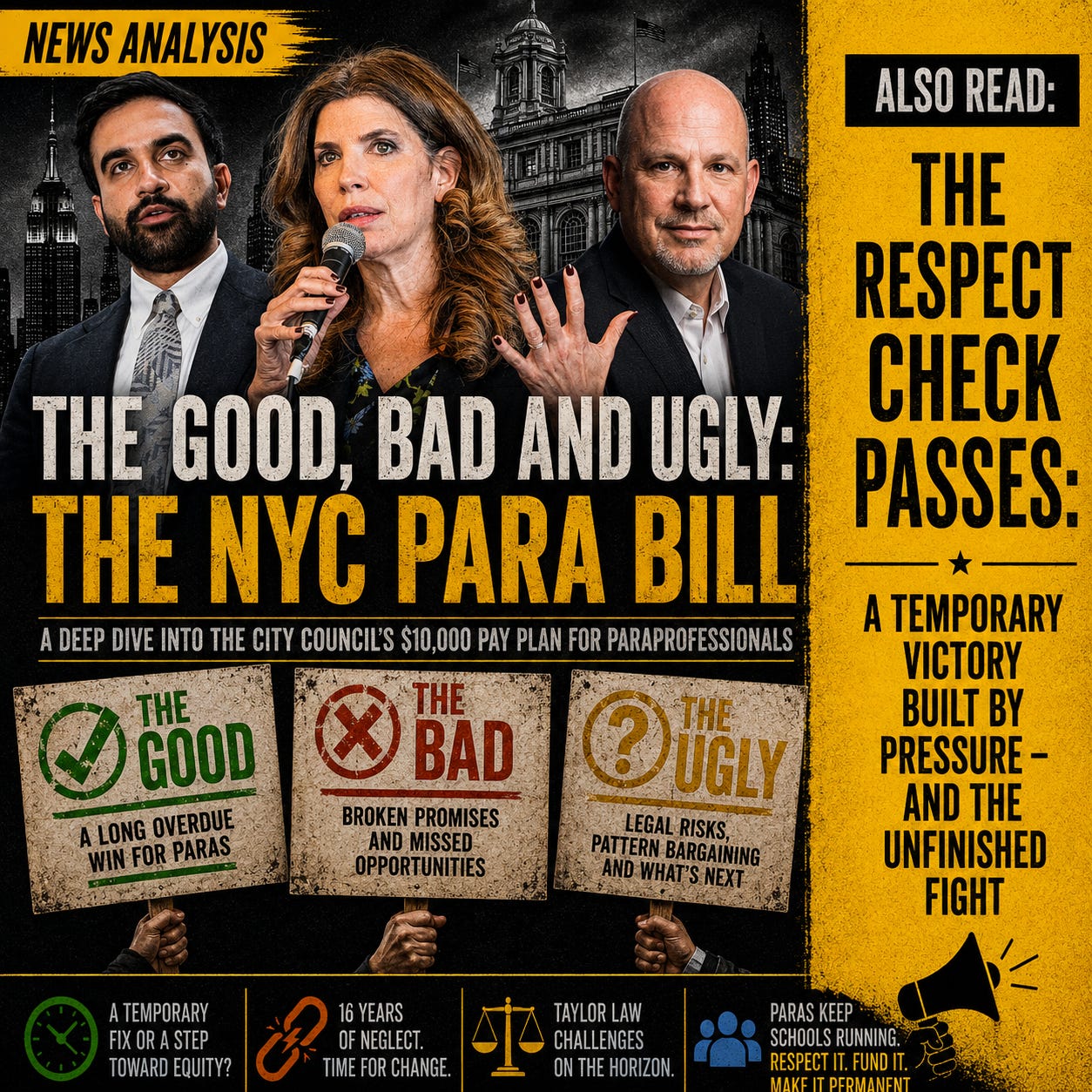
The Respect Check Passes: A Temporary Victory Built By Pressure - And the Unfinished Fight.

On Thursday, the New York City Council approved legislation that would provide eligible Department of Education paraprofessionals with up to $10,000 in additional compensation during the 2026–27 school year.
Mulgrew had $450m in his hands to pay paras more and he chose not to! -- With no real plan to FIX PARA PAY, he and his Unity Caucus shift blame to pattern bargaining.

We never get to see the costing summary sheets of city union contracts with the City… but here is UFT ’s last one. And what it reveals is pretty alarming.
That photo of Mulgrew and Menin is creepy, with his hand on the back of her neck.
Thank you for breaking down the issues that can and explaining it fully.
Bottom line, I agree that any monies in the pockets of paraprofessionals is well well deserved.
But our union must do better for us .