


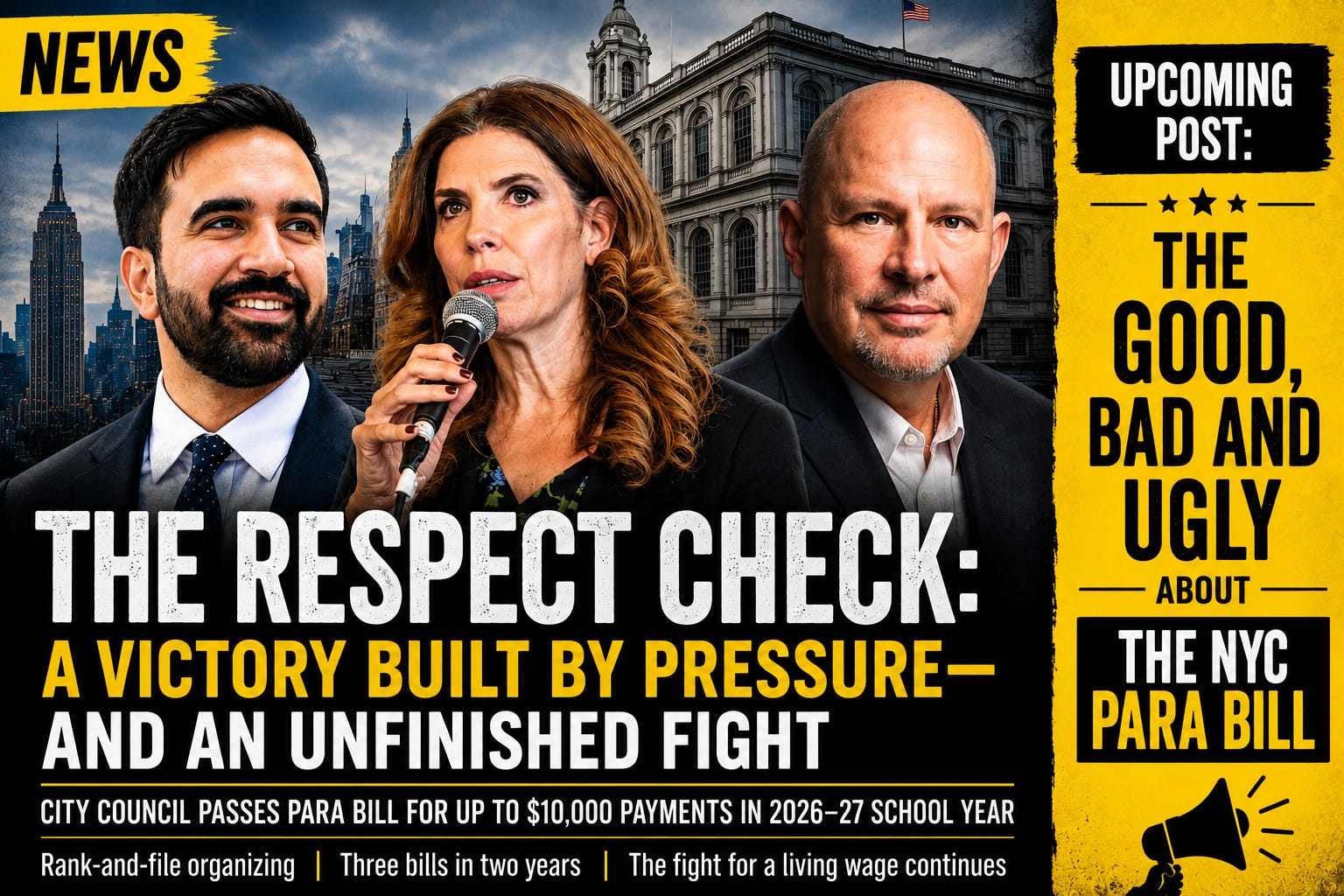
On Thursday, the New York City Council approved legislation that would provide eligible Department of Education paraprofessionals with up to $10,000 in additional compensation during the 2026–27 school year.
The campaign for this legislative fix has been dubbed “The Respect Check” by the educators union that authored it, the United Federation of Teachers.
The measure passed unanimously (49-0) and would provide the money in four installments beginning in January 2027. Supporters say it addresses a recruitment and retention crisis among one of the city’s lowest-paid school workforces. Critics question whether the legislation can withstand legal scrutiny under New York’s Taylor Law, which generally reserves wages and compensation for collective bargaining.
But this story didn’t begin in City Hall. It began inside the union hall of the United Federation of Teachers.
For years, paraprofessionals argued they had become the forgotten workforce inside New York City’s schools.
They support students with disabilities, help manage classrooms, assist with communication, behavior intervention and personal care—yet many struggled to afford the city where they worked.
That frustration eventually became organized.
Where The Pressure Was Born
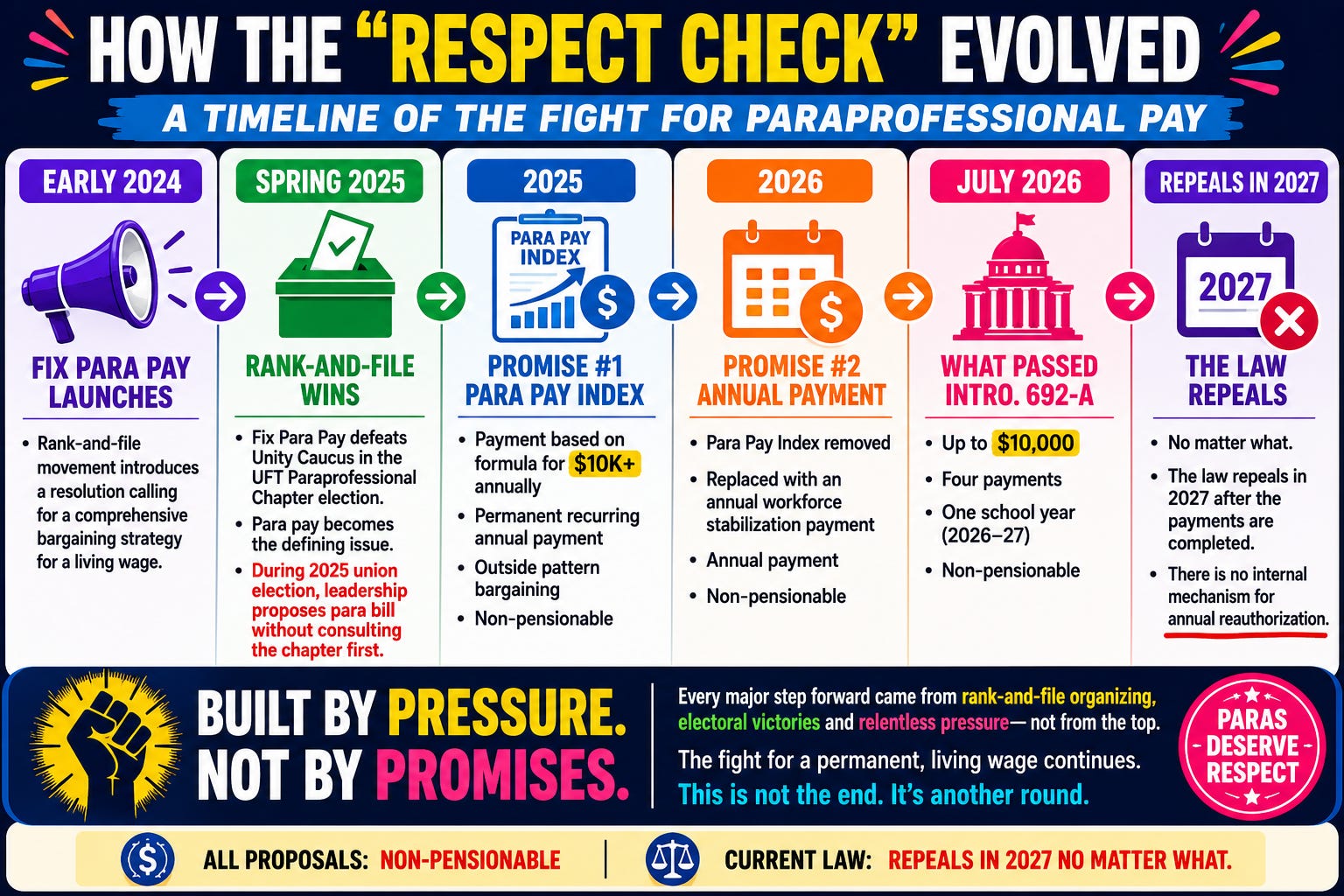
In early 2024, a rank-and-file movement known as Fix Para Pay began demanding a living wage and introduced a resolution calling on the UFT to support national legislation supporting better pay and conditions for school-related professionals and to develop a comprehensive bargaining strategy to achieve one. The proposal sought a concrete plan—not simply another round of percentage raises produced through pattern bargaining, the long-standing system in which municipal unions generally negotiate the same percentage increases regardless of title or profession. The resolution was ultimately amended by the union’s leadership, removing the requirement for a comprehensive, robust bargaining plan.
The debate didn’t end there. It only intensified.
Months later, in the spring of 2024, the Fix Para Pay slate defeated Unity Caucus in the UFT Paraprofessional Chapter election, overwhelmingly with 75% of the vote. The historic win ended decades of Unity control over the chapter and made paraprofessional pay the defining issue within that division of the union.
Its platform focused on a living wage, better longevity increases, line-of-duty injury compensation, stronger due process protections and greater involvement by working paraprofessionals in decisions affecting their compensation and working conditions.
The debate over paraprofessional pay also drew renewed attention to choices made during the UFT’s 2022–27 contract negotiations. A November 2024 report by The Wire, citing a contract costing summary, estimated that the agreement devoted roughly $450 million to recurring, non-pensionable retention payments distributed across UFT titles. The report argued that union negotiators could instead have directed a larger share of that money toward paraprofessionals and other hard-to-staff positions.
UFT leadership defended the equal payments as fair, while critics said distributing the same amount broadly missed an opportunity to address the much deeper wage crisis facing the most in need — paraprofessionals, the union’s lowest-paid members.
The episode became part of the larger rank-and-file argument that paraprofessional compensation required a targeted bargaining strategy after decades of stagnant wage increases —not simply the same percentage raises and payments applied across the workforce.
The Shrinking Promise
Following the 2024 rank-and-file victory, during the spring 2025 UFT general election campaign, as union leadership sought re-election, they unveiled a legislative proposal promising to close the paraprofessional pay gap.
That legislative proposal would eventually evolve through three different versions.
The first version, introduced in 2025, proposed creating a Para Pay Index—a non-pensionable annual payment of more than $10,000 based on a formula outside traditional collective bargaining that would begin offsetting decades of pattern bargaining. It was presented as a permanent solution to begin narrowing the wage gap.
That proposal stalled.
The second version, introduced in 2026, abandoned the Para Pay Index and replaced it with a non-pensionable annual workforce stabilization payment, shifting away from a formula-based approach toward legislatively authorized annual payments.
Then came the third version—Intro. 692-A.
The legislation approved this week authorizes four non-pensionable payments totaling up to $10,000 for eligible paraprofessionals employed during the 2026–27 school year. Unlike earlier proposals, it does not establish an ongoing annual payment and instead limits the benefit to one school year. The law also repeals itself in 2027, meaning any future payments would require entirely new legislation.
Where Things Stand Now
The bill now goes to Mayor Zohran Mamdani, who supported increasing paraprofessional pay with a “Respect Check” while running for mayor but now says the Council’s approach may violate New York’s Taylor Law.
The mayor and his administration argue that compensation should be resolved through collective bargaining and say they are reviewing the legislation and considering their next steps.
It remains unclear whether he will sign or veto the bill within the 30-day window.
City Hall insiders say a legal challenge remains possible, even as supporters call the legislation long-overdue recognition.
Critics call it nothing more than a Band-Aid and temporary relief.
Either way, one thing is beyond dispute.
This represents the most significant targeted effort to address paraprofessional compensation in decades. It has brought unprecedented attention to the economic struggles of paraprofessionals and thrust their fight for a living wage into the center of New York City’s political conversation.
Whether one celebrates the legislation or questions its long-term viability, one conclusion is difficult to escape:
Without years of rank-and-file organizing, a competitive para chapter election, and sustained targeted pressure from working paraprofessionals themselves, this conversation likely never reaches City Hall.
Editor’s note: We will follow up with a deep dive news analysis of this bill, its immediate and future impact, in tomorrow’s companion piece: The Good, The Bad and The Ugly.
Related links:
Chalkbeat: Council approves $10k perk for public school paraprofessionals
Daily News: NYC Council approves $10K checks for teacher aides, Mamdani considers ‘next steps’
Daily News: Council paraprofessionals bill breaks N.Y. law
The Wire: The Newly Revised UFT Para Bill: The Promise That Kept Shrinking
Union Matters: Real Respect for Paras
Mulgrew had $450m in his hands to pay paras more and he chose not to! -- With no real plan to FIX PARA PAY, he and his Unity Caucus shift blame to pattern bargaining.

We never get to see the costing summary sheets of city union contracts with the City… but here is UFT ’s last one. And what it reveals is pretty alarming.

No one is saying part out loud. While this check gives them four installments of $2500 across two fiscal years, the only thing this could potentially help is retention. And that’s because none of these workers will be able to retire on a livable pension because this is non-pensionable money. The minute they retire this money goes away.
It is dependent on the union reopening the contract right now and negotiating an increase like OLR said they could in the previous hearing. And if the UFT refuses to do that now, the only other opportunity would be at the next round of bargaining when their contract expires in 2027. But why wait. Because if the UFT could reopen his contract right now and give these people a pensionable wage, why wouldn’t they?
Because as you so eloquently put it, they had the money the last time to do it. This isn’t a failure of The City, this is a failure of the union leadership.
Another Mamdani option , do nothing, the bill becomes law after thirty days … Mamdani can’t afford to alienate Black and Latina women across the city