


There are stories that announce themselves with a bang.
Then there are stories that quietly stack one fact on top of another until the picture becomes impossible to ignore.
One bill.
One lobbying campaign.
One endorsement controversy.
One internal email.
One paid political advertisement.
And finally...
One declaration of “all-out war.”
Standing alone, each has an explanation.
Taken together, they raise a far more uncomfortable question.
Who declared war?
Michael Mulgrew?
Or the members?
According to a recent New York Times report, UFT President Michael Mulgrew warned that if Mayor Zohran Mamdani did not support the paraprofessionals’ bonus legislation, it would mean “all-out war.”
Every union leader is expected to fight for members.
No one should apologize for demanding better pay for paraprofessionals.
That isn’t the issue.
The issue is something deeper. More than union leadership will let on.
Before the president of a member-funded union commits the organization to political war with a mayor, who decides that war should be fought? And how?
That isn’t a question about Julie Menin.
It isn’t even primarily a question about Michael Mulgrew.
It’s a question about whether one of the nation’s largest teachers’ unions is becoming less member-driven at precisely the moment its members are demanding more democracy and voice.
Let’s begin with what this article is not.
It is not an attack on the Respect Check legislation.
Years before politicians held press conferences or campaign operatives celebrated legislative wins, paraprofessionals were packing organizing meetings, organizing co-workers, flooding City Hall and union leadership with emails, speaking at rallies, signing petitions and refusing to let their poverty wages become another forgotten promise.
That movement belonged to New York City’s paraprofessionals.
It did not belong to any politician or highly paid union staffer taking victory laps or selfies at City Hall.
Which makes what happened afterward worth examining.
Because somewhere between the organizing and the victory, the focus began to shift.
From the members who built the movement...
...to the politicians who claimed the credit.
Exhibit A: The Investment in Menin
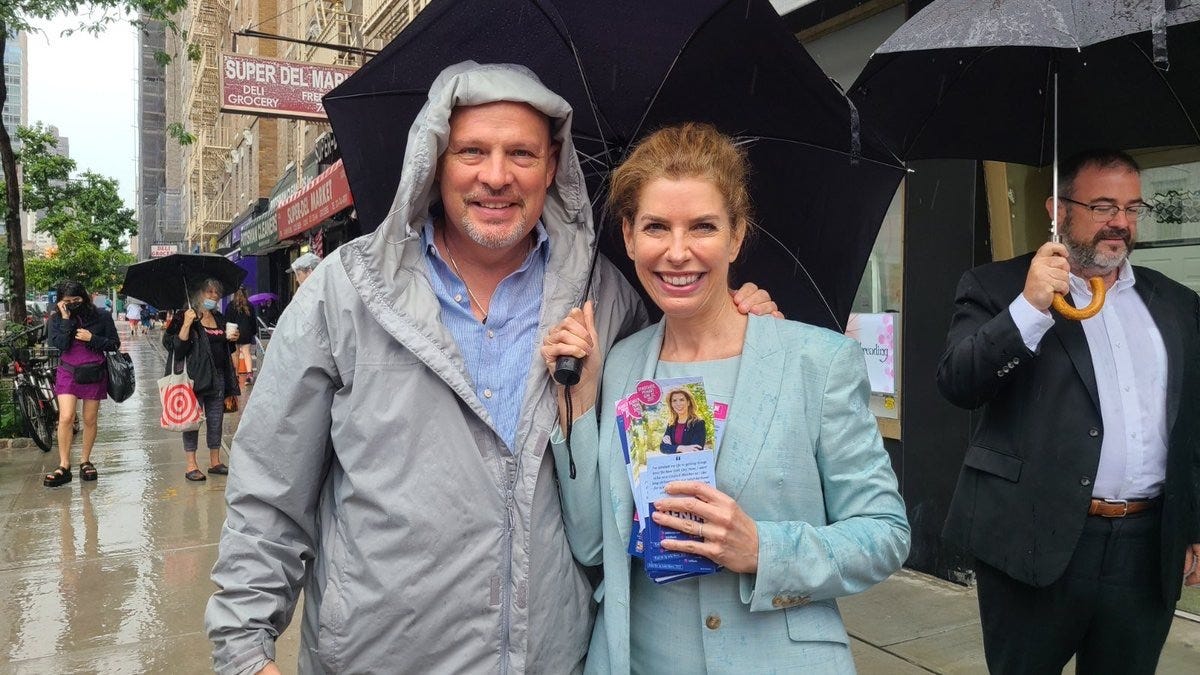
Before the Respect Check was passed by City Council, UFT leadership had already made a significant political investment in City Council Speaker Julie Menin.
Campaign finance records show that United for NYC’s Future, an independent expenditure committee aligned with UFT leadership, spent more than $210,000 supporting Menin’s City Council campaign.
She received the second-largest amount of support from that committee among all candidates during the most recent election cycle.
Only Dermot Smyth—a longtime UFT political operative who ultimately lost his race—received more.
That fact deserves attention for another reason.
Unlike many Council races, Menin faced no widely recognized serious challenge for her seat.
None of this suggests anything illegal.
Independent expenditures are lawful.
Political alliances are common.
But political investments are rarely made without expectations.
They build relationships.
They create influence.
And they often shape what comes next.
Around City Hall there has been persistent speculation that Menin may someday seek higher office, perhaps even the mayoralty if circumstances change.
As of this writing, she has announced no such plans.
Still, viewed against that backdrop, what followed becomes harder to dismiss as coincidence.
Exhibit B: The Mobilization Against Mamdani


The next piece of the story came not from City Hall...
... but from an internal union email.
According to the internal email obtained by POLITICO, members were instructed to arrive before the mayor’s appearance so “the mayor and others can see them as they enter.”
Pause there.
Forget whether you’re a supporter of Mamdani.
Forget whether you’re a supporter of Menin.
Or neither.
Ask a simpler question.
When a powerful elected official asks a union president to assemble members for a political event...
whose event is it?
The union’s?
Or the politician’s?
Members deserve an answer.
Exhibit C: The Recent Paid Advertisement
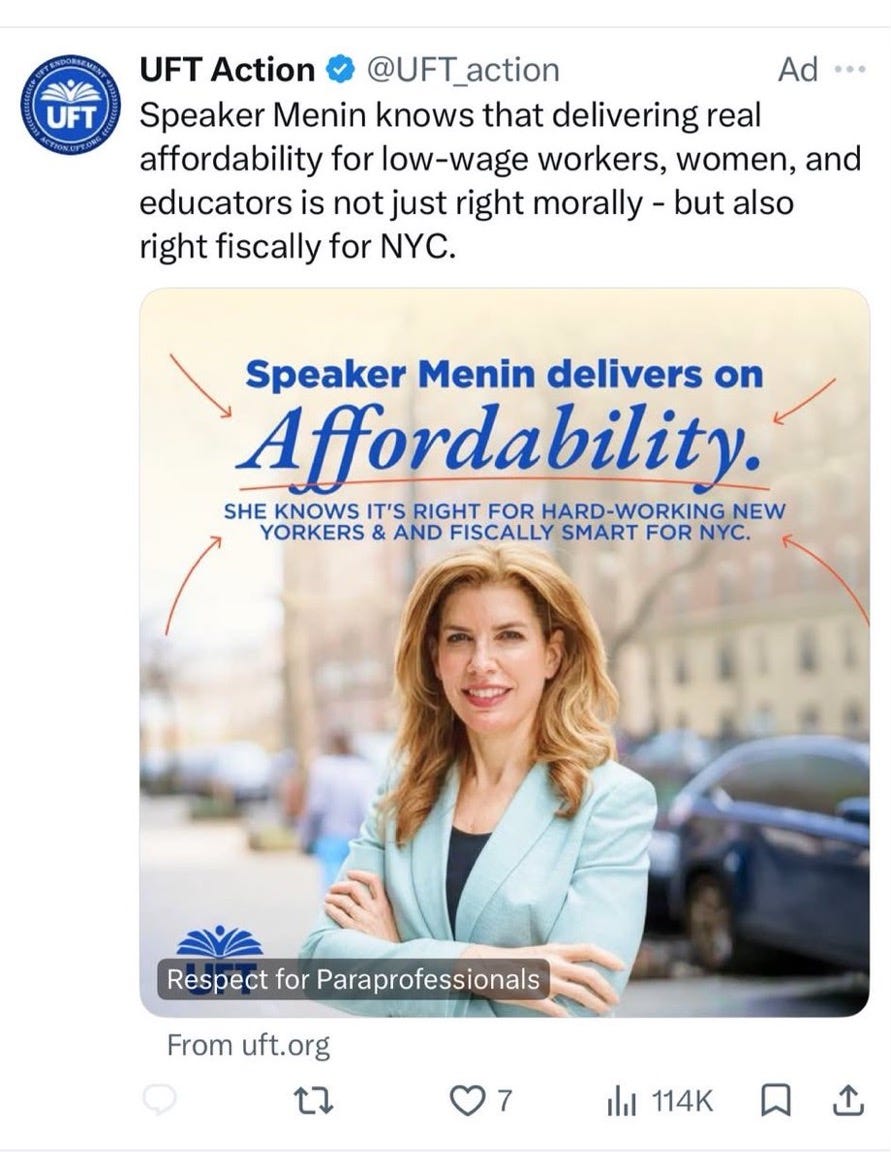
Then came the paid advertisement after the Menin-led City Council passed the paraprofessional legislation, which Mayor Mamdani has publicly questioned because of possible Taylor Law issues.
A paid social media advertisement.
Not from an outside advocacy organization.
From UFT Action—the union’s political operation.
It did not celebrate years of rank-and-file organizing.
It did not feature the paraprofessionals whose persistence made the legislation possible.
Instead, it featured one politician beneath a headline that read:
“Speaker Menin Delivers on Affordability.”
Think about that wording.
Not “Respect Check Delivers.”
Not “Paraprofessionals Win.”
Not “Members Made This Happen.”
Speaker Menin Delivers.
And not simply on paraprofessional pay.
On affordability.
That word wasn’t chosen in a vacuum.
Affordability became the defining message of Zohran Mamdani’s successful mayoral campaign and remains central to his political identity.
Whether intentional or not, the advertisement did more than celebrate legislation.
It sounded more like a dig at Mamdani coupled with a boastful post-touchdown juke.
It positioned Speaker Menin within the city’s defining affordability narrative and working families’ struggles.
It wasn’t merely legislative messaging.
It was preferential political branding and possibly a tacit endorsement of Menin’s future political aspirations.
And members have every right to ask why their union’s COPE-funded political operation chose to spend resources delivering that message without consent.
Exhibit D: The Pattern
If this all sounds familiar, that’s because UFT members had already been debating a similar question.
The Goldman-Lander endorsement controversy was never really about Dan Goldman or Brad Lander who ran against each other in the District 10 Democratic congressional primary.
It was about who controls the UFT’s political voice.
Leadership publicly announced support for Goldman before the Delegate Assembly—the union’s highest policymaking body—had voted. Then used union resources to canvass for him.
That distinction mattered.
Had NYSUT endorsed first, many members would have viewed the announcement as part of the normal state endorsement process.
Had the Delegate Assembly voted first, members would at least have known their elected representatives had spoken.
Neither had happened.
Instead, members were left with the reasonable impression that the endorsement had effectively been announced from the top down.
Whether that perception was fair or not, it became the catalyst for a broader debate that had been building inside the union for years.
For nearly sixty years, Unity caucus has governed the UFT through a highly centralized leadership model.
Today, that model faces its most sustained internal challenge in decades.
Reform groups like A Better Contract argue that endorsements, political strategy, and major decisions should flow upward from the membership—not downward from leadership. They support direct member voting when it comes to major political endorsements.
Viewed through that lens, the Menin story becomes something larger than one politician.
A substantial, mostly unilateral political investment.
A close, coordinated legislative partnership.
A reported request to mobilize members.
A paid political advertisement centering the same elected official coronated as the legislation’s “champion”.
An endorsement controversy.
Each event has its own explanation.
Together, they tell a story.
Exhibit E: The Declaration of “All Out War”
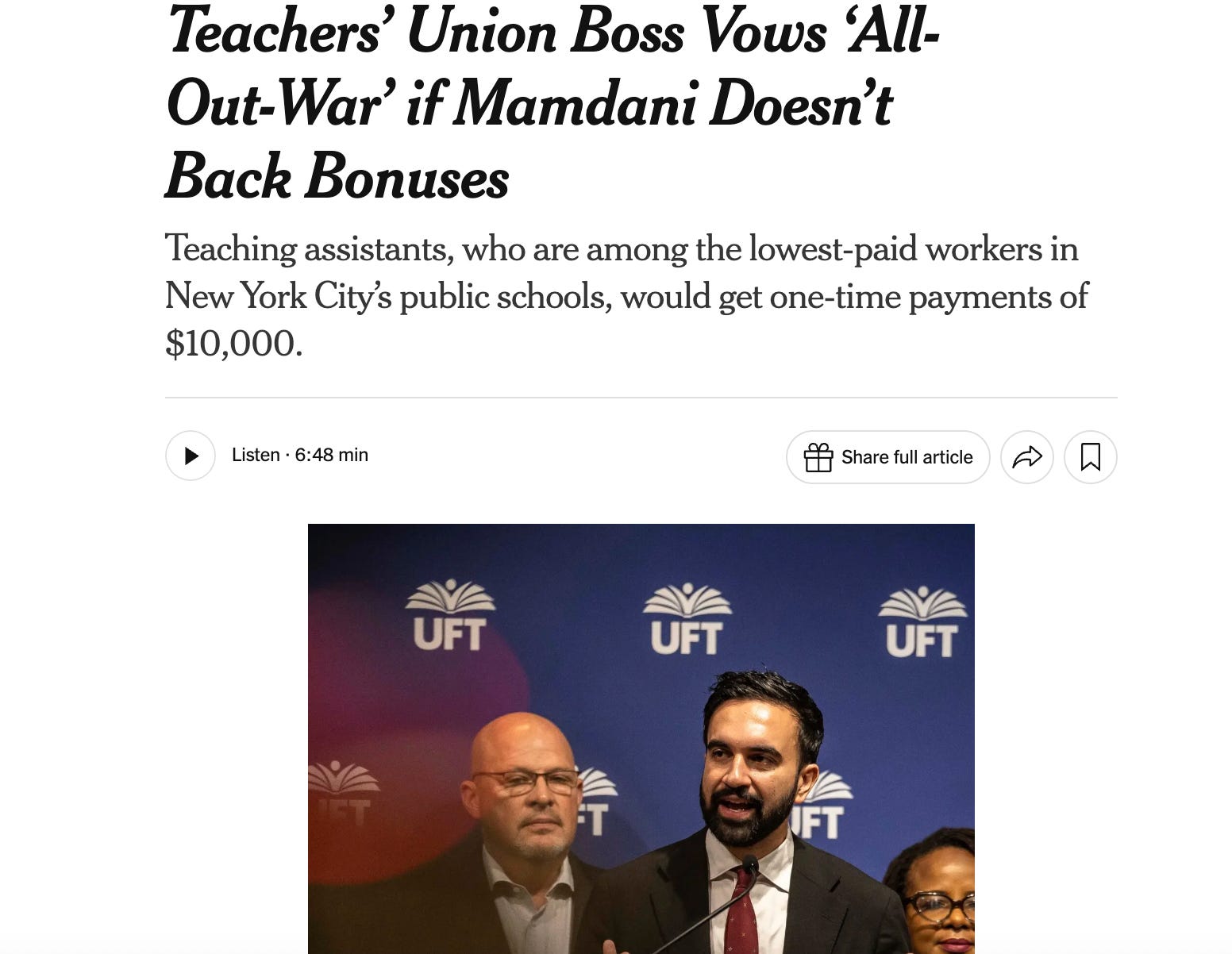
Then came the New York Times piece.
The dispute over Respect Check had moved beyond City Hall.
According to the Times, UFT President Michael Mulgrew warned that if Mayor Mamdani refused to support the paraprofessional payments, it would mean “all-out war.”
Importantly, Mayor Mamdani has never argued that paraprofessionals do not deserve higher pay. Instead, he has argued that a permanent living wage should be won through collective bargaining, not through legislation he believes could conflict with New York State’s Taylor Law.
Every union leader is expected to fight for members — especially in the inevitable disagreements that will arise between a mayor, who also represents management, and union labor.
That isn’t the issue.
The issue is something different.
When does a president speak for members...
and when does he presume to speak as the members?
Declaring, or even suggesting, “all-out” political war is one of the most consequential statements a union leader can make.
It commits not simply one individual, but the political weight of hundreds of thousands of educators.
Which brings us back to the central question.
Did the members vote for that confrontation? Did they even help craft the para bill and its campaign strategy?
Did the Delegate Assembly authorize any of these decisions? Or did it serve as a “rubber stamp” after the fact?
Did COPE members debate it?
Or did they simply read about it afterward?
That distinction matters.
Because a member-led union doesn’t simply ask members to fight.
It asks whether they want the fight and how they should do so in the first place.
To be clear, there is no evidence presented here of unlawful conduct, campaign finance violations, or improper coordination.
That isn’t the argument.
The concern is something different.
That the line between representing members and advancing political relationships appears to be growing thinner.
That decisions with significant political consequences increasingly appear to originate at the top while members learn about them afterward.
That the union’s political machinery is becoming more centralized under Mulgrew at the very moment members are demanding the opposite.
Those aren’t legal questions.
They’re democratic ones.
The Bottom Line
Every organizer.
Every COPE dollar.
Every paid advertisement.
Every mobilization.
Every political endorsement.
Every declaration of political war.
Exists because educators built this union.
Not Michael Mulgrew.
Not Julie Menin.
The members.
That is why so many questions are being raised as a result of the New York Times piece matters.
It isn’t whether Mayor Mamdani is right.
It isn’t whether Speaker Menin is right.
It isn’t even whether the Respect Check strategy ultimately succeeds.
The question is much simpler.
When the UFT speaks politically, who decided what it would say?
Because if the answer is no longer the members, then the most important battle facing the union isn’t taking place at City Hall.
It’s taking place inside the union hall itself.
Members deserve greater transparency about how major political decisions are made.
They deserve to know how COPE dollars are being spent. They deserve to see COPE meeting minutes.
They deserve confidence that endorsements reflect established democratic processes.
And they deserve to understand whether declarations as consequential as “all-out war” against a candidate the union hastily endorsed — asserting that he aligned to our priorities — and if this represents the considered, informed judgment of the membership—or simply the judgment and whims of its top-down leadership.
A union derives its legitimacy not from its president, but from its members.
When that distinction begins to blur, asking questions isn’t disloyal.
It’s the very essence of union democracy.


The politicians need to visit the public schools in NYC and observe the assignments of paraprofessionals. The challenges and circumstances that the paraprofessionals face on a daily basis. Paraprofessionals are involved with their 1:1 and the other students inside or outside the classroom. Paraprofessionals provide academic and behavior support to the pupils. Our workload is heavy and our stress level is heightened. We are overworked, but underpaid. Politicians it is expensive in reside in NYC. Give the paraprofessionals the $10,000! In addition, paraprofessionals should receive student loan forgiveness not in 10 years instead in 5 years, and up to $15,000 waived. Affordable housing for paraprofessionals.
Unity is a political party within the UFT, as are ABC and other political parties, usually referred to as caucuses. Unity, just like Democrats in Albany meet among ourselves, debate, discuss the issues of the day… before every session in Albany the Democrats meet, in private, discuss, debate and follow the caucus decisions on the floor.
The UFT endorses incumbents who have pro labor and education records, a message to other electeds. Goldman was the incumbent.
Hooking up with Menin was smart politics, she nailed down the Speakership early, in spite of declining enrollments there were no budget cuts.
The UFT has almost 200,000 members, forty or so districts, chapter leaders meet with district representatives monthly, decisions, to the extent possible reflect the views of members.
To constantly trash UFT leadership is applauded by our enemies, and we have plenty of enemies, from Trump to Bloomberg to the billionaire Charter and school voucher supporters.
“Agreeing to disagree” on issues and working together are possible in a mature relationship, seems out of the question.
The UFT was a key player in budget policies to bail out Mamdani, his flipping on pay boost is unacceptable…
Mulgrew’s tough words were warranted.