


For years, city workers and retirees have been told a familiar story:
Healthcare concessions were necessary, painful but unavoidable, and required to generate “cost savings” for the City. We were told these sacrifices were about sustainability. About protecting benefits. About avoiding worse outcomes.
We needed to save and replenish the depleted NYC Healthcare Stabilization Fund – or it would collapse, and we would have no choice but to pay healthcare premiums.
But buried in plain sight is an admission that turns that entire narrative on its head.
In a recent closed-door Municipal Labor Committee meeting, MLC and UFT attorney Alan Klinger acknowledged that a central goal of the City–Union Tripartite Health Committee was not to save the Healthcare Stabilization Fund (HSF)—but to eliminate it altogether.
Not through open debate. Not through a vote of the MLC body. But through a quiet, structural decision made by a tiny group of three individuals operating far from rank-and-file eyes and ears.
When asked about why the City no longer would meet its obligations to pay benefits for 9/11 widows and orphans through the HSF, Klinger told the MLC’s union leaders:
“And the city said, no. They said that because the stabilization fund is going to be exiting the stage — which was frankly one of the principal goals of the tripartite health committee.”
“Because the stabilization fund construct that had worked pretty well for 35 to 38 years was no longer working because of the inversion of how equalization did.”
“And so I’m working with Scheinman as the chair of the tripartite. He said that we had reverse incentives to try and keep the stabilization fund that was keeping us from doing the things that were better for everyone. So part of the goal of the last several years was to move away from the stabilization fund construct.
— Alan Klinger, MLC lawyer, speaking to MLC leaders on September 30, 2025. The same day the MLC voted to approve the new self-funded NYCPPO plan.
Let that sink in.
The Stabilization Fund—created in the mid-1980s to equalize healthcare costs across unions and protect benefits during economic downturns—was not merely allowed to weaken. According to Klinger, it became an obstacle that needed to be removed.
A Decision Made Without the Members?
Klinger explains that he was “working with Scheinman as the chair of the tripartite,” referring to neutral arbitrator Martin Scheinman, alongside City Office of Labor Relations (OLR).
The Healthcare Tripartite committee exists as part of the 2014 and 2018 healthcare agreements. It is primarily tasked as a labor-management board to advance the cost containing goals of the healthcare agreements.
Together, Klinger confesses, they concluded that the Fund—which had “worked pretty well for 35 to 38 years”—was no longer desirable because of how equalization now functioned.
But what’s missing from this account is just as important as what’s said.
There is no reference to a vote of the MLC delegates over this matter.
No reference to past member consultation. No admissions to misusing the fund beyond its intended purposes. No mention of past disclosures that dismantling the Stabilization Fund had become an explicit objective.
Instead, Klinger describes a top-down strategic shift, driven by what the committee believed was “better for everyone,” even as the consequences fell hardest on those with the least voice—retirees, widows, orphans, and vulnerable beneficiaries.
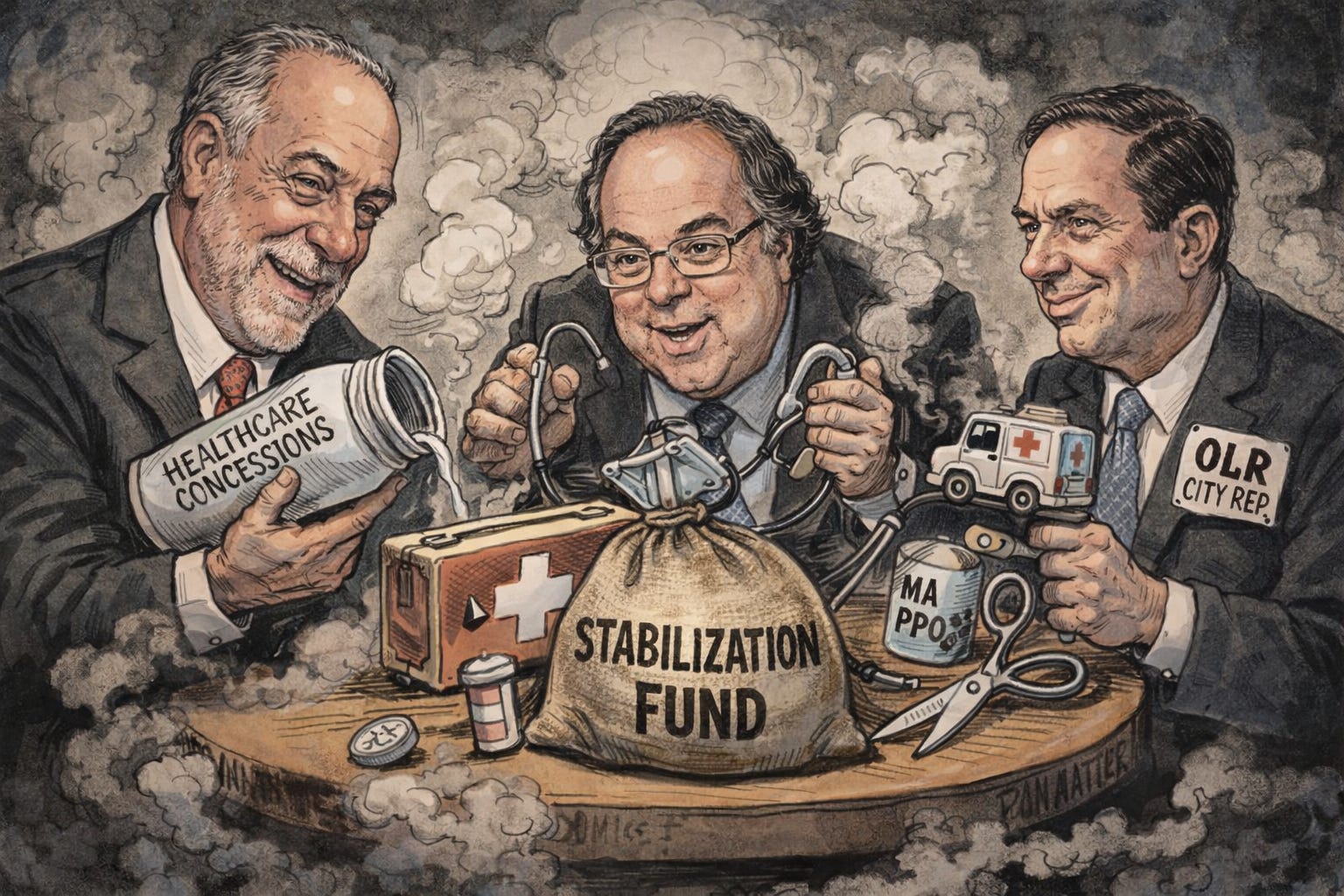
The 9/11 Widows and Orphans: Collateral Damage
Nowhere is this more devastating than in the defunding of the 9/11 Widows and Orphans benefit—a program historically supported through the Stabilization Fund.
When questioned about why those benefits could not be guaranteed beyond the third quarter, Klinger relayed the City’s position plainly:
“The city said no… because the stabilization fund is going to be exiting the stage.”
In other words: the benefit wasn’t cut because savings simply failed to materialize.
It wasn’t cut because the City lacked resources.
It was cut because the funding mechanism itself was being intentionally dismantled, after being misused.
This reframes the issue entirely.
“Cost Savings”—or Structural Elimination?
For years, members were told healthcare concessions had to be accepted to “generate savings” that would protect the system. But Klinger’s remarks seem to reveal a deeper, emerging truth: those savings were never meant to sustain the Stabilization Fund long-term.
In fact, he acknowledges that the committee believed the Fund created “reverse incentives” that prevented them from doing what they thought was “better for everyone.”
So which is it?
If healthcare givebacks were about preserving stability, why was the very structure designed to provide that stability targeted for removal?
If concessions were about shared sacrifice, why were the most morally unassailable benefits—those for 9/11 families—allowed to hang by a thread?
Why then were NYC retirees forced to organize and crowd fund to litigate for over three years in order to fight the City’s and MLC’s inferior, predatory, cost saving Medicare Advantage plan?
If equalization was an issue, why was the HIP rate suppressed or reduced in FY 2016 as a “cost savings” measure when it further drained the Stabilization Fund?
A Promise Deferred, Not Guaranteed
Klinger attempts to soften the blow by suggesting that if projected savings exceed estimates in the new NYCEPPO plan, the MLC could “come back to OLR” and try to restore funding later.
But this is not a safeguard.
It is a contingency.
A hope.
A political gamble.
And critically, it places the burden of restoration on future negotiations, with an unknown carousel of City officials, rather than embedding protections where they once existed—inside a dedicated fund created for exactly these moments.
The Bentkowski Hypocrisy: Defending the Fund in Court While Undermining It in Practice
The most striking hypocrisy emerges when Klinger’s statements are placed alongside his sworn legal position in the Bentkowski litigation — the city retiree-led lawsuit challenging the City’s and MLC’s attempt to impose mandatory enrollment into a Medicare Advantage plan.
In that case—still actively litigated through this year—Klinger filed an affirming amicus brief on behalf of the MLC, in support of the City.
In that filing, he forcefully defended the Stabilization Fund as a legitimate, essential, and jointly administered mechanism that supports our existing healthcare, PICA drug benefits, chemotherapy costs, and even a widows’ and orphans’ benefit—explicitly rejecting claims that the Fund was a “slush fund”. Furthering the claims that recent “cost savings” decisions were intended to save and replenish the fund.
Yet now, in his most recent MLC remarks, Klinger acknowledges that one of the Tripartite Committee’s principal goals over “the last several years” was to move away from that very same Stabilization Fund construct.
He cannot credibly maintain both positions at once. Either the Fund was a vital, lawful pillar of collectively bargained benefits deserving judicial protection—or it was an outdated structure leadership was quietly working to eliminate.
What Bentkowski reveals is not just inconsistency, but a troubling dual strategy: defend the Fund in judicial court to preserve bargaining leverage and weaponize its depletion in the court of public opinion to justify benefit reductions and higher out-of-pocket costs, while dismantling it behind closed doors without member approval.
The Core Question the MLC and Unions Must Answer
The issue is no longer technical. It is democratic.
Who authorized the decision to “move away” from the Stabilization Fund? When exactly was this decision made “several years ago”?
When were MLC leaders and delegates told this was a primary goal?
Why were union members asked to accept concessions without being told the Fund itself was being phased out?
Alan Klinger’s own words make one thing unmistakably clear: this was not an accident, a misunderstanding, or an unavoidable outcome.
It was a strategy.
And the people most affected were never given a seat at the table.
MLC union leaders, it’s time to speak up.
Mr. Mulgrew, where were you when this decision to move away from the Stabilization fund was first hatched? What did you know? And, when did you know it?
Mr. Klinger. Mr. Scheinman. These are our tax dollars. Our dues. Our funds. Our unions.
You three need to exit the stage. But not before being held accountable.
Open the books. Let’s see that audit.
The “Transparent, Fair” Tripartite Committee?
You decide.

Related articles:


Editor’s note: The audio provided above also contains some other unsettling details — including an arbitration case in which the City insists that PICA drugs, once paid for by the Stabilization Fund, be the obligation of the welfare funds once again. Klinger says if this path continues, it will be “crippling”. Also, there is an acknowledgement that hundreds of millions are somehow still owed to the City beyond the savings the NYCEPPO plan is projected to generate.
We will unpack all of this and more in a future post.
Klinger also provides council to the UFT, DC 37 and other unions. He has many conflicts of interests and gets away with them. I’m grateful this is beginning to get exposed. We need to see the comptrollers audit of the stabilization fund ASAP.
Here’s an interesting history:
Table 1. History of the Health Insurance Stabilization Fund
Year Event Details
1982 GHI-CBP offered Employer’s cost “equalized” between GHI-CBP and HIP-HMO.
1985 HISF created GHI-CBP/HIP-HMO rate difference deposited by the City into HISF (if positive).
1995 Transfer of Blue Cross/GHI reserves Reserves for claims Incurred But Not Reported (IBNR) transferred to HISF. These reserves are non-disposable.
2001 Benefits funded HISF starts funding PICA and other health benefits.
Transfers to the City $95 million to the City’s general fund.
2005* Benefits funding transferred Funding for psychotropic and asthma drugs transferred to welfare funds.
Transfers to City $36 million annually.
Transfers to welfare funds $100 per annum employee and retiree recurring, plus additional $100 in FY 2005.
2009 Transfers to the City Transfer of $121 million plus recurring $112 million.
Transfer to welfare funds Transfer of $117 million.
2014 Transfer for collective bargaining $1 billion from HISF to pay for wages and benefits.
Transfers to welfare funds $150 million over four years, and $60 million recurring afterward.
HIP-HMO rate reduction Lowers inflows/increases outflows.
2018 Transfer to welfare funds $200 per member (lump sum).
2021-present Medicare Advantage (MA) contract If implemented, savings of $600 million/ year to be deposited into HISF.
2023-2024 Transfers suspended $165/year per active employee and retiree contribution to welfare funds (2005, 2014, and 2018 HBAs).**
$112 million/year transfer to the City (2009 HBA).
2024 HISF depleted Disposable HISF balance of $1 million at the end of FY 2024.
https://comptroller.nyc.gov/reports/health-care-costs-the-hidden-risks-in-the-financial-plan/