


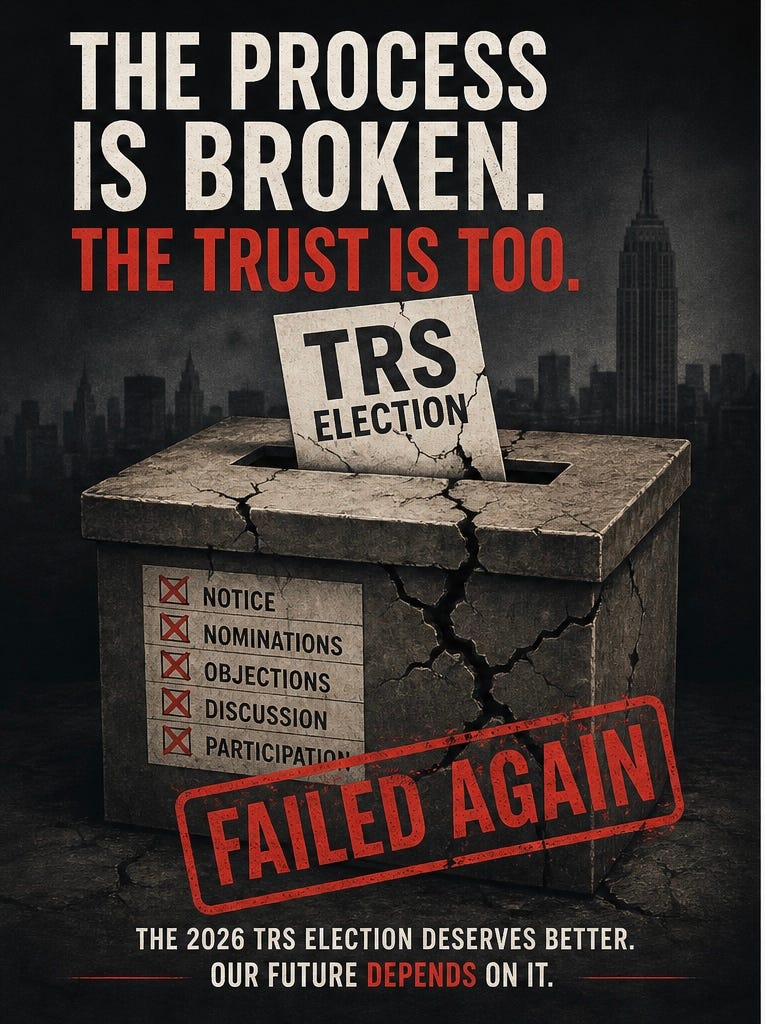
Last year, a court had to step in and say what should never have needed saying: the 2024 TRS election was not conducted according to law.
This was not a technical finding. It confirmed that the process itself broke the law.
That should have been the end of it.
A clear ruling. A clear mandate. A chance to fix the system.
Instead, we are watching the same failures unfold again—this time in real time, and on a wider scale.
I’m writing this not as an outside observer, but as someone directly involved.
I am a middle school teacher, an active TRS contributor, a petitioner in the Article 78 case that challenged the 2024 election, and a former candidate who served as an alternate to Ben Morgenroth. On Thursday, April 30, I sent a formal letter to the Chancellor, the Chancellor’s designee, Corporation Counsel, and UFT leadership raising urgent concerns about what is happening right now.
I will be attaching that letter, along with the judge’s decision, because what is unfolding in the 2026 TRS trustee election is not new.
It is a repeat.
Why 2024 Was Different—and Why That Matters Now
For decades, TRS trustee elections were not meaningfully contested. In most cycles, only one candidate appeared on the ballot. The outcome was effectively predetermined. There was little incentive for outreach, and little awareness among members that an election was even taking place.
The system functioned—but quietly, and without scrutiny.
That changed in 2024.
For the first time in many years, there was a real contest. Multiple candidates. Competing visions. And now, in 2026, there is the very real possibility of more than two candidates on the ballot for the first time in what is likely half a century.
That should have triggered a shift—a recognition that a real election requires real communication.
Instead, it exposed how unprepared the system is when participation actually matters.
The lack of notice, the confusion around timelines, using an electronic poll to conduct a paper ballot election and the absence of systemwide communication were not new problems. They were longstanding weaknesses that had been masked by uncontested races.
Once there was real competition, those weaknesses became impossible to ignore.
And the court confirmed it.
A Law That Is Old—But Not Unclear
The court did not say the DOE came close. It said the law was not followed .
It is true that §13-507 was written more than 70 or 80 years ago, for a much smaller system. But while the law may be dated, its expectations are not ambiguous. The steps are clearly laid out. The timelines are fixed.
Notice.
Nominations.
Objections.
Publication.
Discussion.
Vote.
And the court ordered that future elections must follow that sequence .
That was the reset.
Instead, the Same Breakdown
The DOE issued its 2026 election memo on January 26, laying out deadlines and procedures. On paper, it reads as compliance.
But the entire process depends on one basic condition: members must know it is happening.
The memo required that the notice be conspicuously posted where staff can see it.
That didn’t happen.
In my April 30 email to the Chancellor and others, I cited polling data from hundreds of educators across the largest DOE online community— a group with over 40,000 members.
The results are stark:
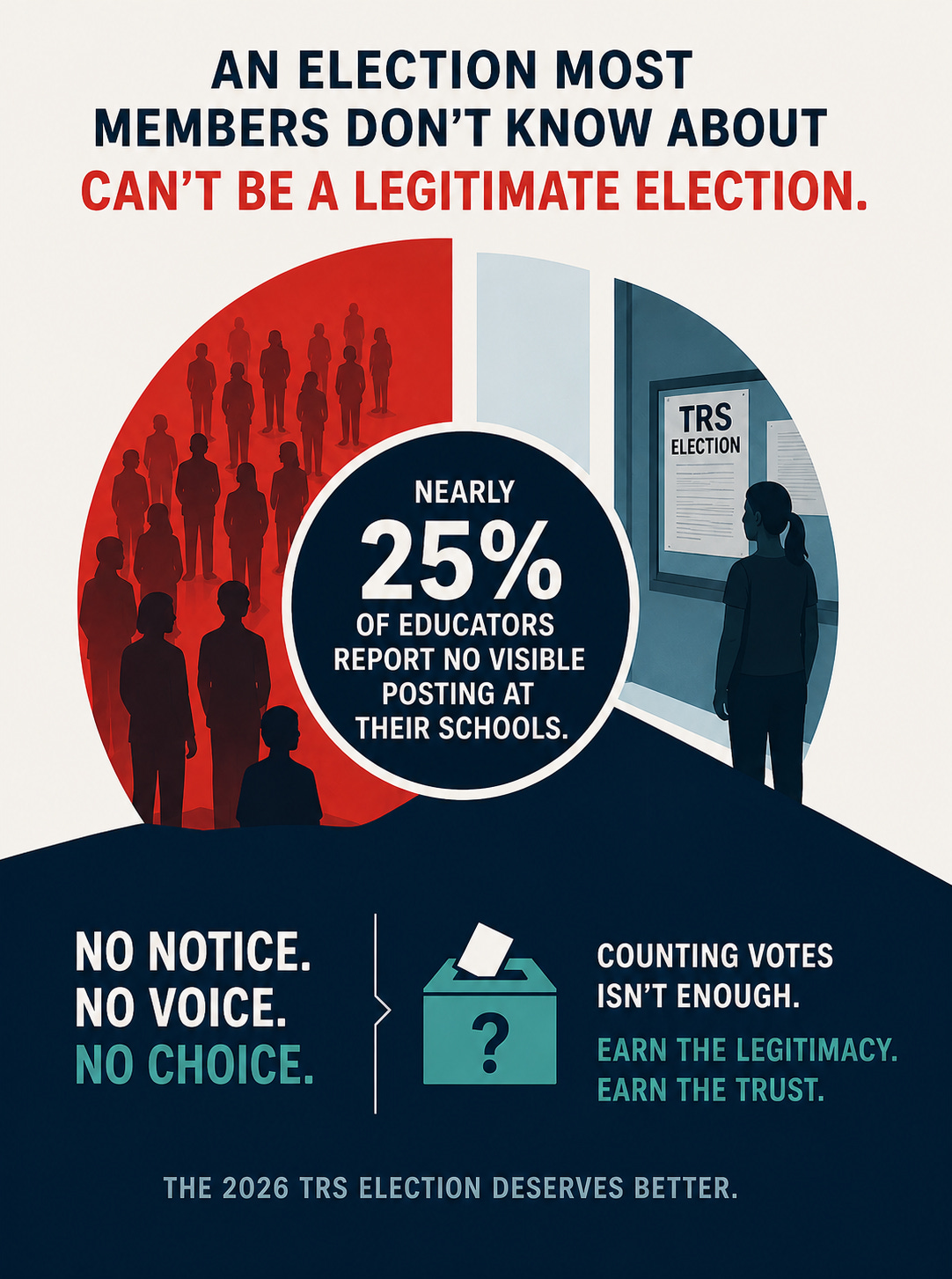
Roughly three-quarters, 75%, reported no visible posting.
Another 20% shared that they were unsure.
Only a small fraction, hovering 5%, could confirm the notice was actually posted.
This is not uneven compliance. It is systemic failure.
By the time many members realized an election was underway, the key deadlines had already passed.
When Notice Fails, the Election Fails
The nomination deadline passed on April 17.
The objection deadline passed on April 24.
These are the moments when members are supposed to shape the election.
But those rights depend on timing. And timing depends on notice.
As I wrote in my letter, the failure here did not simply violate a requirement—it collapsed the statutory process itself .
Because what does it mean to have the right to nominate a candidate if you never knew nominations were open?
What does it mean to object if the window closes before you knew it existed?
How to you inform yourself about the choices for an election, if you don’t know its happening?
At that point, participation is not limited. It is eliminated.
Rights That Exist Only on Paper
The law includes a safeguard: if 10% of contributors in a school request it, a meeting must be held to discuss the candidates.
In theory, this is how members engage, question, and decide.
In reality, it requires awareness, coordination, and time.
None of those conditions existed.
Reaching 10% of a staff that does not know an election is happening is not difficult.
It is impossible.
That right has not been weakened. It has been functionally erased.
Minimizing Responsibility While the System Fails
According to CSA, the DOE has told schools their role is “limited” to making information “readily available”—essentially posting the memo and waiting.
But even that limited expectation is not being met.
And yet, to reiterate, polling shows that more than three-quarters of educators report no visible posting in their schools.
That distinction matters.
The law requires active, uniform, and verifiable notice. What is being described instead is a passive model—posting without verification, and no real systemwide effort to ensure it is actually seen.
After a court has already found noncompliance, that approach raises a basic question:
Is the City complying with the law, or simply going through the motions?
What’s at Stake
This is not a symbolic election. A TRS trustee helps oversee more than $130 billion in pension assets. Decisions made at that table, like the proposed pension smoothing/reamortization scheme and calls for issuing pension obligation bonds, affect every educator in the system.
And at this moment when pension financing and risk strategies are actively being discussed, the legitimacy of that representation matters.
If the process is compromised, the outcome cannot be insulated from that fact.
The Process Moves Forward—But the Foundation Is Broken
The election calendar continues.
Candidates will be published.
Ballots will be distributed.
Votes will be cast.
Results will be counted .
But each step assumes something that is no longer true—that the electorate was informed and had a fair opportunity to participate.
Proceeding under these conditions does not fix the problem. It locks it in.
What Real Correction Looks Like
If there is to be any credibility in this process, corrective action must be immediate and real.
That means direct systemwide communication to every TRS contributor—not passive posting.
It means ensuring all candidates can present themselves to members in a way that actually reaches schools.
That includes distributing written and video statements from each candidate, along with clear notice that members have the right to organize school-based forums.
If participation is guaranteed in law, it has to exist in practice.
The Bottom Line
The court already said the law was not followed in the DOE’s bungled 2024 election.
Everyone involved had the opportunity to ensure it did not happen again.
And yet here we are.
At some point, this stops being about whether procedures were imperfect.
It becomes about whether the process itself can still be called an election.
Because if most members never knew it was happening…
if their rights existed only on paper…
if the system moved forward anyway…
Then the votes may be counted.
But the legitimacy and integrity are not.
What can we do? Organize. Send emails to the Chancellor, union leadership and elected officials. Share this post widely.
Related links:
The candidates for 2026 TRS teacher trustee election:
Very interesting read. Very educational- much appreciated!