


NYC paras were left behind.
Where I part company with the board is over what happens next — and who gets to play hero now that everybody has discovered that a school worker making barely $33,000 can’t afford New York City.
The Daily News says UFT President Michael Mulgrew “failed” paraprofessionals at the bargaining table and “basically left the paras behind.”
That’s the sentence worth remembering.
Because before there was a RESPECT Check, before Mayor Zohran Mamdani sued to stop it, and before politicians started holding press conferences about paraprofessional poverty, paras themselves had already revolted.
In the last UFT paraprofessional chapter election, in 2024, Fix Para Pay — a rank-and-file movement demanding better wages — defeated Mulgrew’s Unity Caucus with roughly 75% of the vote.
That’s not a close election.
That’s a jaw-breaking message.
Only after that political earthquake inside his own union did Mulgrew become the public face of a $10,000 legislative campaign. A lobbying campaign and series of bills in which Mulgrew never once consulted with the UFT paraprofessional chapter over its design or messaging.
That history matters.
So does what happened to the $10,000.
What began as a proposal for an ongoing Para Pay Index was eventually transformed into four non-pensionable payments during the 2026-27 school year.
Then they’re gone.
No permanent $10,000 salary increase. Nothing added to the salary schedule. Nothing for future percentage raises to compound upon. Nothing added to a para’s pension.
If the checks survive the city’s lawsuit, paras should take every penny.
They’ve earned it.
But don’t confuse a temporary check with a raise.
And don’t confuse a political campaign with collective bargaining.
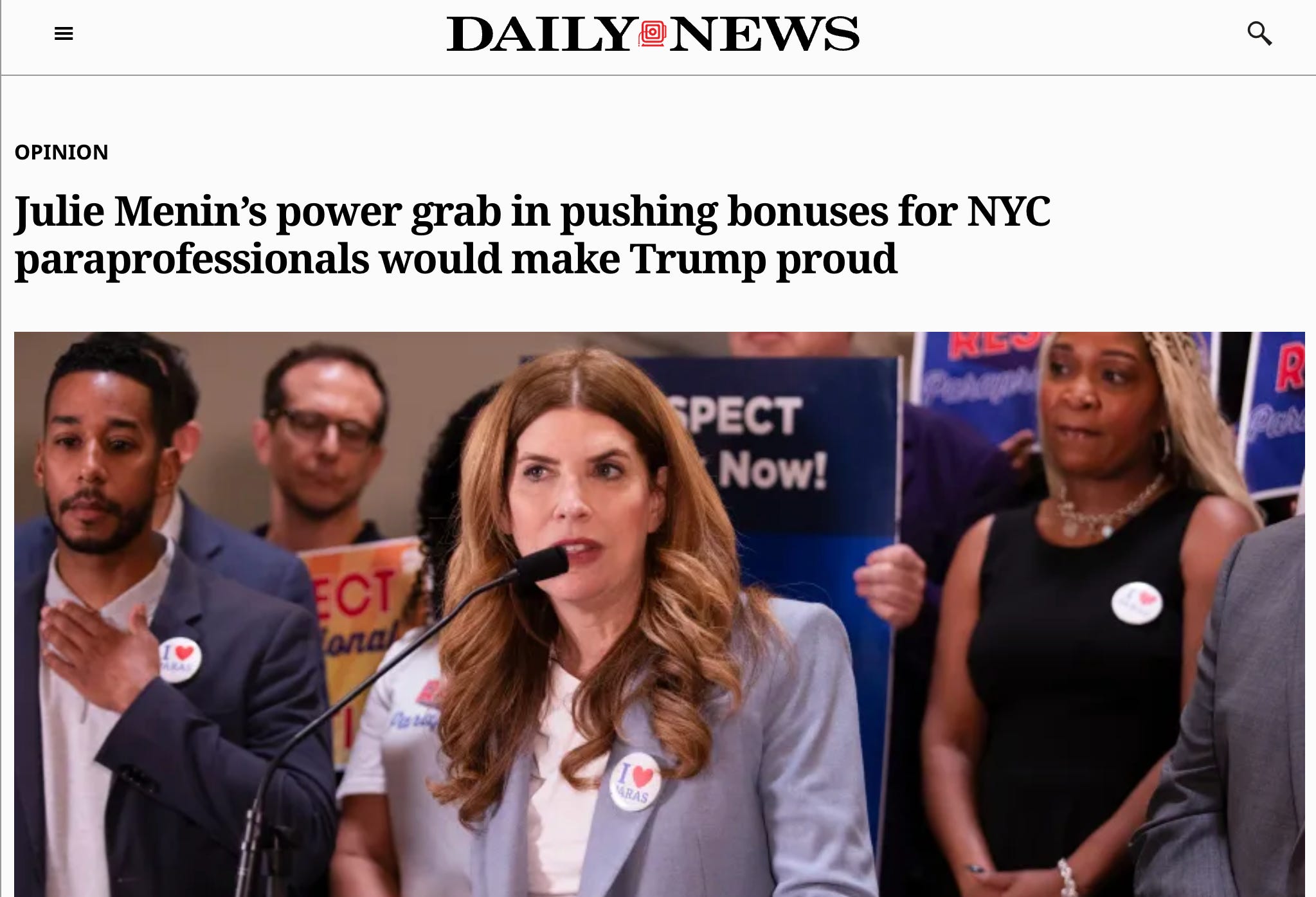
That distinction is getting harder to see because City Council Speaker Julie Menin has wrapped herself tightly around this issue.
Menin deserves credit for putting the miserable wages of paraprofessionals squarely before the public and for pushing money toward workers who desperately need it.
She also deserves scrutiny.
Menin is widely discussed as a potential future mayoral candidate. A Council speaker building a political brand around handing $10,000 checks to tens of thousands of union members should expect questions about where worker advocacy ends and political ambition begins.
The Daily News goes considerably further, calling Menin’s legislation an “abuse of power” and arguing that compensation belongs at the bargaining table under the Taylor Law.
That’s now for a judge to decide.
But the controversy has exposed a larger contradiction.
The Taylor Law Should Not Be Undermined, It Should be Strengthened
Council Member Sandy Nurse recently declared on X that all workers should be entitled to withdraw their labor until satisfactory working conditions are achieved.
That’s a powerful union position.
There’s just one problem.
New York public employees can’t legally strike.
The Taylor Law prohibits it.
So here’s my question to Nurse, Menin, Mulgrew and every politician suddenly speaking the language of militant trade unionism:
Where is this energy for amending the Taylor Law?
Where are the rallies?
Where is the lobbying campaign?
Where is the political pressure in Albany?
If organized labor can mobilize its money, members and political relationships to get the City Council to legislate compensation, surely it can mobilize to lobby for reform of state law that its allies say denies workers their fundamental leverage.
Amending the Taylor Law wouldn’t empower only paraprofessionals. It could give an army of underpaid public workers — crossing guards, school aides, cafeteria workers and others who make this city and state run — greater leverage to fight for a living wage.
And Albany could go further: guarantee every public worker a base wage of at least $30 an hour. If New York can mandate what workers cannot do to fight for better wages, it can certainly establish a wage floor that says public service should not mean working poverty.
And there is an even more immediate question for Mulgrew.
Why isn’t that same organizing muscle being used to win paras a permanent living wage at the bargaining table?
Collective bargaining isn’t an inconvenience for a union to work around.
It’s the union’s fiduciary job.
The Daily News argues that wages and compensation are mandatory subjects of bargaining and that this dispute ultimately belongs back at the negotiating table.
Fine. Put it there.
But this time, don’t send the paraprofessionals back to that table alone.
They’ve already shown what happens when they organize.
They threw out Mulgrew’s Unity caucus leadership in the para chapter by 75%.
That should have been the beginning of something bigger.
Send 25,000 organized paras to the bargaining table with a demand for a permanent living wage – not paid union staffers posing as classroom educators.
Send teachers standing beside them.
Send parents who know who feeds their children, helps them communicate, changes them, calms them, protects them and gets them through the school day.
And send a union leadership who understands that their responsibility isn’t merely to find politicians willing to write paychecks.
It’s to build enough worker power that politicians have no choice but to listen.
The Bottom Line
Menin shouldn’t need paras as a political prop or photo ops.
Mamdani shouldn’t get to promise them money as a candidate and then simply walk away from the political consequences as mayor.
And Mulgrew shouldn’t get to turn a rank-and-file rebellion over poverty wages into a victory lap for himself — even as he failed to deliver 450 million dollars of added value in the last contract into the pockets of paras.
The paras created this moment. They organized. They voted.
They forced their poverty wages onto the political agenda.
Now give them something that doesn’t disappear after four checks in 2027.
Give them a permanent, pensionable living wage guaranteed in their contract, now.
And if the Taylor Law stands in the way of workers exercising the power politicians say they should have, organize to change it.
That’s what unions used to call a labor movement.
And unlike a “RESPECT” Check, a true labor movement doesn’t expire in 2027.
Daniel Alicea is a special education middle school teacher in Far Rockaway who knows firsthand that paraprofessionals are the backbone of New York City’s public schools. He is a UFT delegate and lead organizer with A Better Contract, Fix Retiree Benefits and Educators of NYC. He also is a co-host for Talk Out of School’ on WBAI 99.5 FM.

Any monies in the pocket of paraprofessionals is well-deserved, however, a Band-Aid will not stop the hemorrhaging. We are starting a school year with thousands of vacancies.
Just this morning I saw Michael Mulgrew on TV blaming the mayor for flip-flopping on his campaign promise to Paras.
Just to be clear, Mulgrew told paras that this is $10,000. would increase every year in perpetuity
During the last election cycle. He conveniently failed to mention that..
I for one am sick and tired of paraprofessionals being left behind and thrown under the bus .We are the bloodline of the classrooms.. mulgrew did not consult us as members , instead, we are bombarded by paid unity, staffers telling us what is good for us.
And council speaker Menin is now the face of the respect check.
Michael Mulgrew has failed miserably to fight for paraprofessionals. He takes no responsibility , for the position that we’re in now.. we have been left behind , and now are in limbo in the hands of the politicians and the courts. This is so anti-union. !
Shame on the leadership of the UFT, Michael Mulgrew, and the Unity caucus.
I’m done wearing blue on Wednesdays !!!!
Such is the state of the present generation of “teacher activism”- like Alicea-that uninformed militancy-both ABC and MORE- demands that public service unions can overcome the impact of nation-wide inflation and horrendous housing costs-paid for by the tax-payers!
As a real teacher activist and democratic socialist would tell you, these are nation-wide issues that can only be solved by a national workers’ movement forcing billions of dollars away from war and profit and into the needs and demands of all working people in America-as Weingarten and Mulgrew are now advocating. Learn your history Daniel and read up on the New Deal, Great Society and the movements of Civil Rights, anti-war, feminism, and labor that came together and forced major reforms in our society.
Try doing your homework before you launch your infantile campaign of personal attacks and false narrative.
For those following the ABC leadership, do not be fooled. They do not have the knowledge, the understanding of the students, nor the necessary connections to the communities that we serve.
In the event of some miracle electoral victory, a takeover of the union by either ABC or MORE would truly put both the school system and the UFT in jeopardy because of a leadership that is ignorant, narcissistic and childish.