


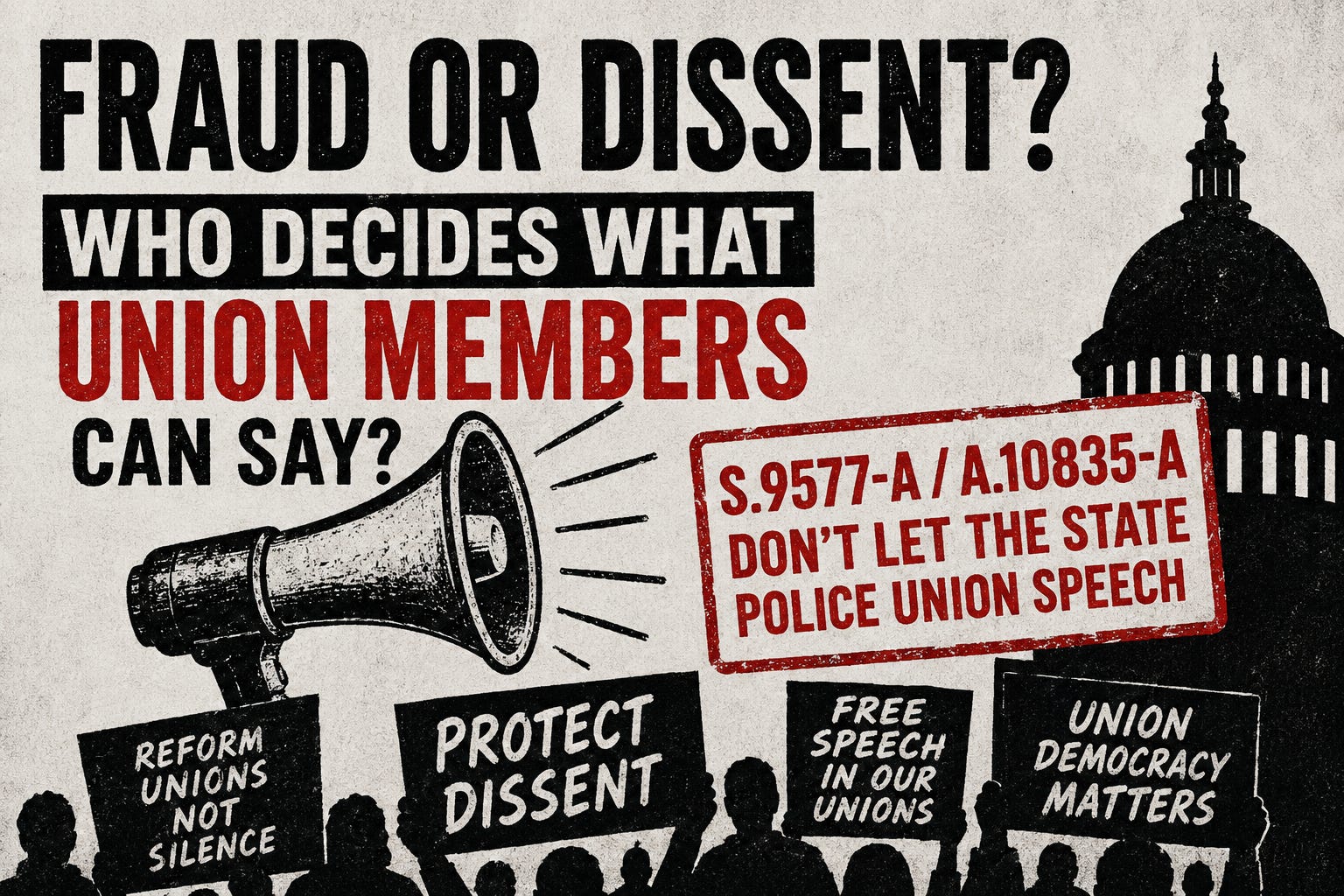
S.9577-A (Ramos) and its Assembly companion, A.10835-A (Griffin), are proposed bills that would create a new section of New York Civil Service Law prohibiting the false impersonation of a public-sector union or union representative through verbal, written, or electronic communications that use fraud, misrepresentation, material omissions, or other deceptive tactics to falsely appear authorized by the union. The legislation is framed as an anti-fraud measure designed to protect union members and employee organizations from deceptive communications intended to mislead recipients or undermine a union’s operations.
The bills also grant significant enforcement authority to the New York Attorney General, instead of unions filing their own lawsuits in courts. Whenever a complaint is filed by a union official and the Attorney General believes there is satisfactory evidence that a person, organization, corporation, association, or other entity has engaged in—or is about to engage in—such conduct, the AG may investigate, commence legal proceedings in the name of the People of the State of New York, seek injunctions and preliminary relief, and pursue civil penalties against alleged violators.
Supporters point to a real problem that emerged after the Supreme Court’s Janus decision. Across the country, anti-union organizations have encouraged public employees to resign from unions, revoke dues authorizations, or otherwise weaken collective bargaining organizations. Some campaigns have relied on mailers, websites, emails, and social media accounts designed to appear official or create confusion among workers.
Viewed through that lens, the legislation appears straightforward: stop deceptive communications and protect workers from being misled.
On the surface, that’s a legitimate goal.
But serious legislation requires us to look beyond the surface.
The question is not whether fraud should be prohibited. Fraud is already illegal. Trademark infringement is already actionable. Identity theft is already unlawful. The real question is why additional legislation is necessary and what kinds of communications lawmakers ultimately intend to reach.
The answer may lie in the language supporters use to justify the bill.
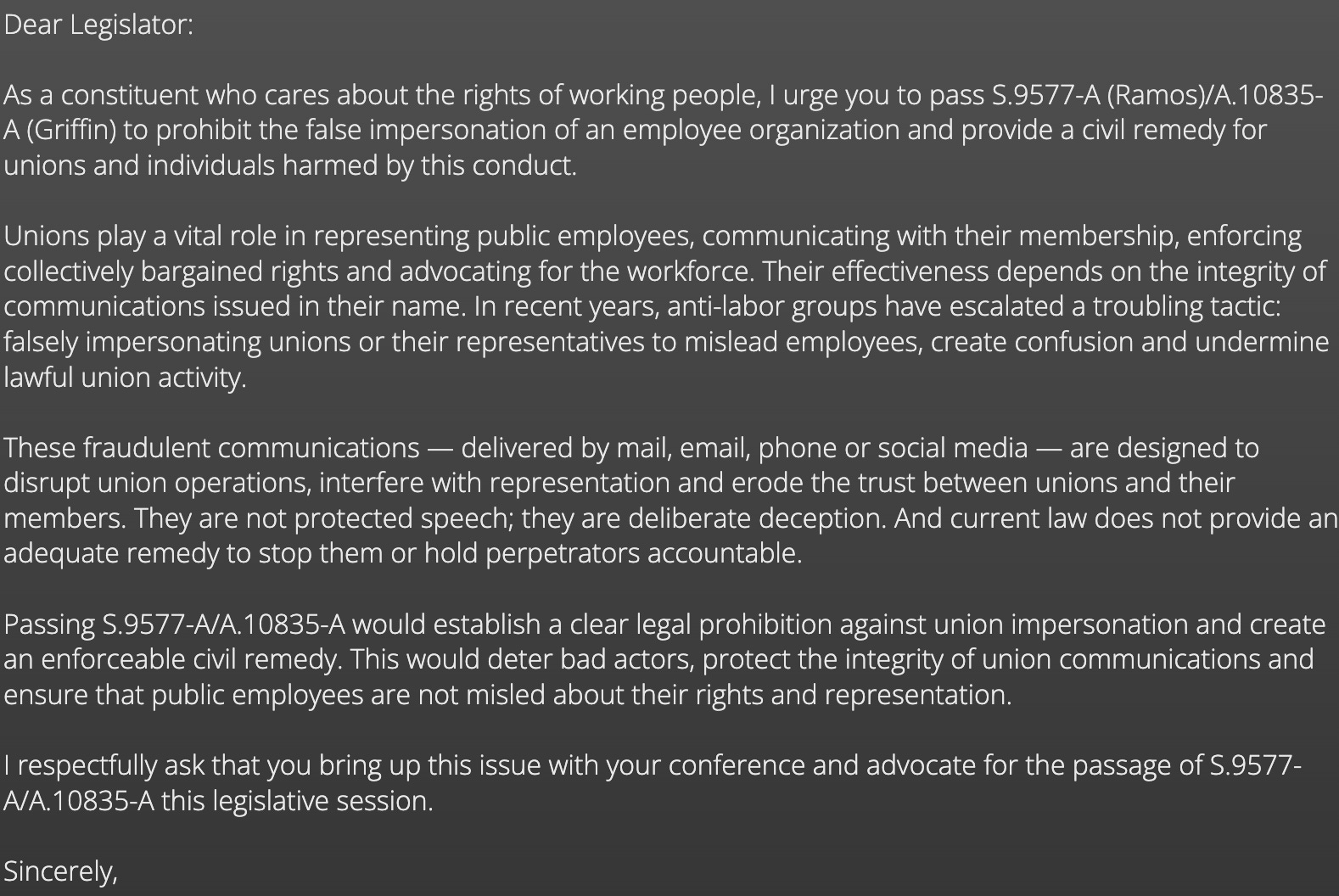
Rather than focusing exclusively on impersonation or false representations, supporters argue that certain communications can “disrupt union operations, interfere with representation, and erode the trust between unions and their members.”
That wording should give union members pause.
Fraud deceives. But “eroding trust” is something entirely different.
That concern is reinforced by the bill’s own supporters. In promoting the legislation, they argue that these communications are harmful because they “disrupt union operations, interfere with representation and erode the trust between unions and their members.”
That language deserves scrutiny. As does language that acknowledges that this goes beyond existing tried-and-true statutes, constitutional rights and existing legal precedence.
Fraud laws are designed to stop deception. But disrupting operations, interfering with representation, and eroding trust are often the byproducts of criticism, whistleblowing, investigative reporting, election campaigns, retiree activism, and reform movements. Some of the most important reform efforts in labor history did exactly that: they challenged leadership, exposed uncomfortable truths, and caused members to question those in power.
If fraud, identity theft, trademark infringement, and other forms of deception are already illegal, then what additional conduct is this bill intended to reach?
A law aimed at stopping someone from falsely claiming to be a union is one thing. A law justified, even in part, by the need to prevent communications that erode trust between members and their union is something else entirely.
Trust is not a legal entitlement. In a democratic union, trust must be earned. Members have the right to criticize leadership, advocate for change, support opposition candidates, publish independent media, and organize around competing visions for their union’s future. Those activities may weaken confidence in incumbent leaders, but that does not make them fraudulent.
Trust can be eroded when members uncover corruption. Trust can be eroded when leadership negotiates a contract members oppose. Trust can be eroded when retirees expose healthcare concessions. Trust can be eroded when rank-and-file caucuses challenge incumbents during elections.
In fact, nearly every reform movement in labor history has been accused of undermining confidence in existing leadership.
That does not make those movements fraudulent.
When Dissent Becomes the Target
The distinction matters because recent events inside New York’s labor movement suggest that disputes over union-related communications are no longer limited to outside anti-union organizations.
An independent arbitration panel rejected the union’s claims. It found that the site was engaged in legitimate, noncommercial commentary and advocacy, that the domain accurately described its intended audience—UFT members—and that it was not attempting to pass itself off as the union. The panel also noted the presence of disclaimers and denied the union’s request to seize the domain.
The significance of the uftmembers.org ruling extends beyond a single website.
It highlights a growing question within organized labor:
Where is the line between fraud and dissent?
That question is particularly relevant because reform caucuses and opposition groups have long used union names in newsletters, campaign literature, websites, and social media accounts. Such communications have traditionally been understood as part of internal union democracy—not evidence of fraud.
Whatever one thinks of the underlying disputes, neither controversy centered on classic fraud or identity theft. Both involved disagreements over how critics, activists, and opposition voices may reference their union when communicating with fellow members.
Where Should the Line Be Drawn?
Consider two hypothetical examples.
A reform caucus launches a website called “UFT Members for Change.” The site criticizes leadership, analyzes union finances, advocates different bargaining priorities, and endorses opposition candidates. Union leaders argue the site creates confusion, interferes with representation and undermines confidence in the organization.
Is that fraud? Or is it protected political speech?
Now imagine a retiree organization publishes a newsletter using the union’s name to identify the retirees it represents. The publication criticizes healthcare concessions, pension policies, and leadership decisions while clearly stating it is not affiliated with union leadership.
Members become angry after reading it. Confidence in leadership declines. Leadership calls it “misinformation”.
Has fraud occurred? Or have members simply been exposed to information leadership would rather not see?
These examples illustrate why the distinction matters.
Everyone agrees that deliberate, malicious impersonation and deception should be prohibited.
The harder question is what happens when criticism, organizing, journalism, advocacy, electioneering, and reform efforts are characterized as communications that “interfere with representation”, “create confusion” or “erode trust.”
That is where the debate moves beyond fraud and into the realm of free speech, union democracy, and the rights of members to organize independently of those currently in power.
The Real Concern
Union leaders may argue that this legislation is aimed solely at deceptive anti-union opt-out campaigns. That may well be true. Those campaigns provide the bill’s strongest political justification.
But legislation must be judged not only by its stated purpose, but by how it can be used in practice.
If lawmakers are concerned exclusively with fraudulent impersonation, the legislation should be narrowly tailored to actual deception.
If concepts such as “interfering with representation” and “eroding trust” become legal standards, however, reform caucuses, retiree organizations, whistleblowers, independent media outlets, and rank-and-file activists may reasonably wonder whether legitimate dissent could someday become the subject of investigation.
That concern grows when combined with the bill’s enforcement structure, which would empower the New York Attorney General to investigate and bring actions involving alleged violations.
While there is no reason to assume any particular attorney general would target lawful dissent, critics often raise concerns whenever broad enforcement discretion is paired with ambiguous, loose standards. If terms such as “interfering with representation”, “creating confusion” or “eroding trust” are left undefined, future enforcement decisions could become entangled with political pressures, complaints from influential organizations, or disputes over internal union communications.
Critics often raise concerns whenever vague language is combined with significant enforcement discretion. Future complaints from influential organizations, political allies, or entrenched leadership groups could place pressure on authorities to investigate communications that are controversial, critical, or disruptive—but not fraudulent.
Nor is the concern merely theoretical.
Several UFT caucuses already incorporate the union’s name into their identities, including A Better Contract-UFT, New Action-UFT, MORE-UFT, Retiree Advocate-UFT, and Solidarity-UFT. Their purpose is often to persuade members that current leadership is failing them. By definition, their communications challenge leadership narratives and may erode trust in incumbent officers while using the union name as an identifier.
That is the essence of democratic debate — especially in a union.
Ironically, the leadership caucus of the UFT, Unity-UFT, uses UFT in its name, logo and social media handles. Yet, leadership is using the same arguments for these bills that it has in legal actions against its opponents while seeking to suppress protected speech within the union.
If the concepts embedded in this legislation evolve from political complaints into legal standards, the line between combating fraud and criminalizing union dissent could become dangerously thin.
The Goldstein and uftmembers.org disputes further illustrate the risk. Whatever one’s view of those controversies, they demonstrate how quickly union-related communications can become the subject of legal challenges when they are perceived as threatening established leadership. Legislation that expands penalties for communications deemed disruptive or misleading could create future opportunities to target critics, reformers, and dissidents whose real offense is not fraud, but opposition.
There is another question legislators should answer. If fraud, trademark infringement, identity theft, and deceptive communications are already illegal, why is a new law needed specifically for unions?
Once the state creates a special statutory protection for communications involving unions that does not exist for many other organizations, it is fair to ask whether the law is simply targeting fraud—or whether it is creating a new shield around labor organizations and their representatives under the AG’s office.
The answer matters. The broader the protection, the greater the risk that criticism, reform campaigns, retiree advocacy, independent media, and internal union dissent could someday be viewed not as political speech, but as legal violations.
History teaches that institutions rarely describe criticism as criticism.
They describe it as disruption.
The labor movement has always depended on workers’ ability to communicate with one another, organize independently, challenge leadership, and advocate for change. Those activities can be uncomfortable. They can create tension. They can even reduce confidence in those currently holding office.
But they are not fraud.
Before Albany grants new powers to police communications involving labor organizations, legislators should carefully determine whether the problem they are attempting to solve is deception—or dissent.
The answer may determine whether this bill protects union democracy and free speech or unintentionally undermines them.
Related:
UFT Members Win: A Better Contract’s Daniel Alicea Defends Free Speech, Beats Back Union’s California Lawyers

In a resounding victory for internal union democracy and free speech, Daniel Alicea, NYC educator, a co-founder of the A Better Contract slate and the original domain registrant of UFTmembers.org, successfully defeated a UDRP complaint brought by the leadership of the United Federation of Teachers (UFT) and its team of high-priced California lawyers.
My Union Dues Pay Lawyers to Threaten Me

Posted with the permission of the author, Arthur Goldstein. Originally posted on Arthur’s blog: http://nyceducator.com/2023/04/my-union-dues-pay-lawyers-to-threaten-me.htm

legislators should carefully determine whether the problem they are attempting to solve is deception—or dissent.
The answer may determine whether this bill protects union democracy and free speech or unintentionally undermines them.
The Union leadership doesn’t like criticism or dissent even while some of their folks churn out disrespectful articles, call others unkind names and promote inaccurate information which hurts and undermines all members. Shouldn’t they be judged by the same standards they claim against those who have just criticisms of Union leadership/ decisions? I hope the legislators think carefully before voting on these bills.
There's nothing new about the union screwing over it's retirees. We fight for our rights and what we were promised under contract even though NYC and our UFT neglect, cheat, and steal from those of us who rightfully deserve what we were promised under contract.