They gave their working lives and health to the New York City public school system. Some suffered career-ending injuries. Others endured violent assaults, underwent surgeries and were left with permanent disabilities. They retired with modest pensions, trusting the retirement system and the union to which they had paid dues for years.
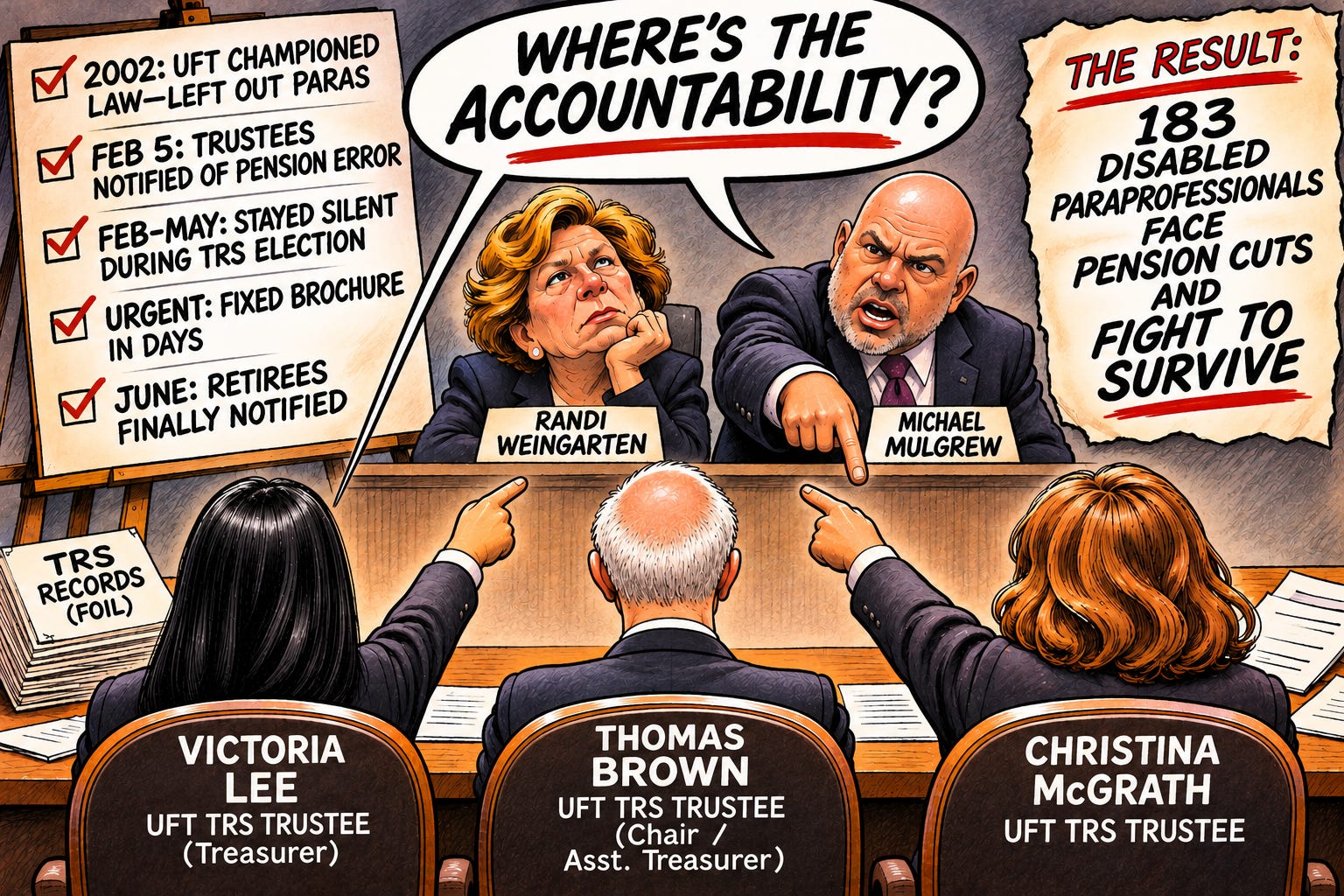
Now, 183 retired paraprofessionals face financial devastation.
And the top leadership of the United Federation of Teachers has some serious explaining to do.
Two disturbing revelations have emerged that fundamentally change our understanding of this pension scandal.
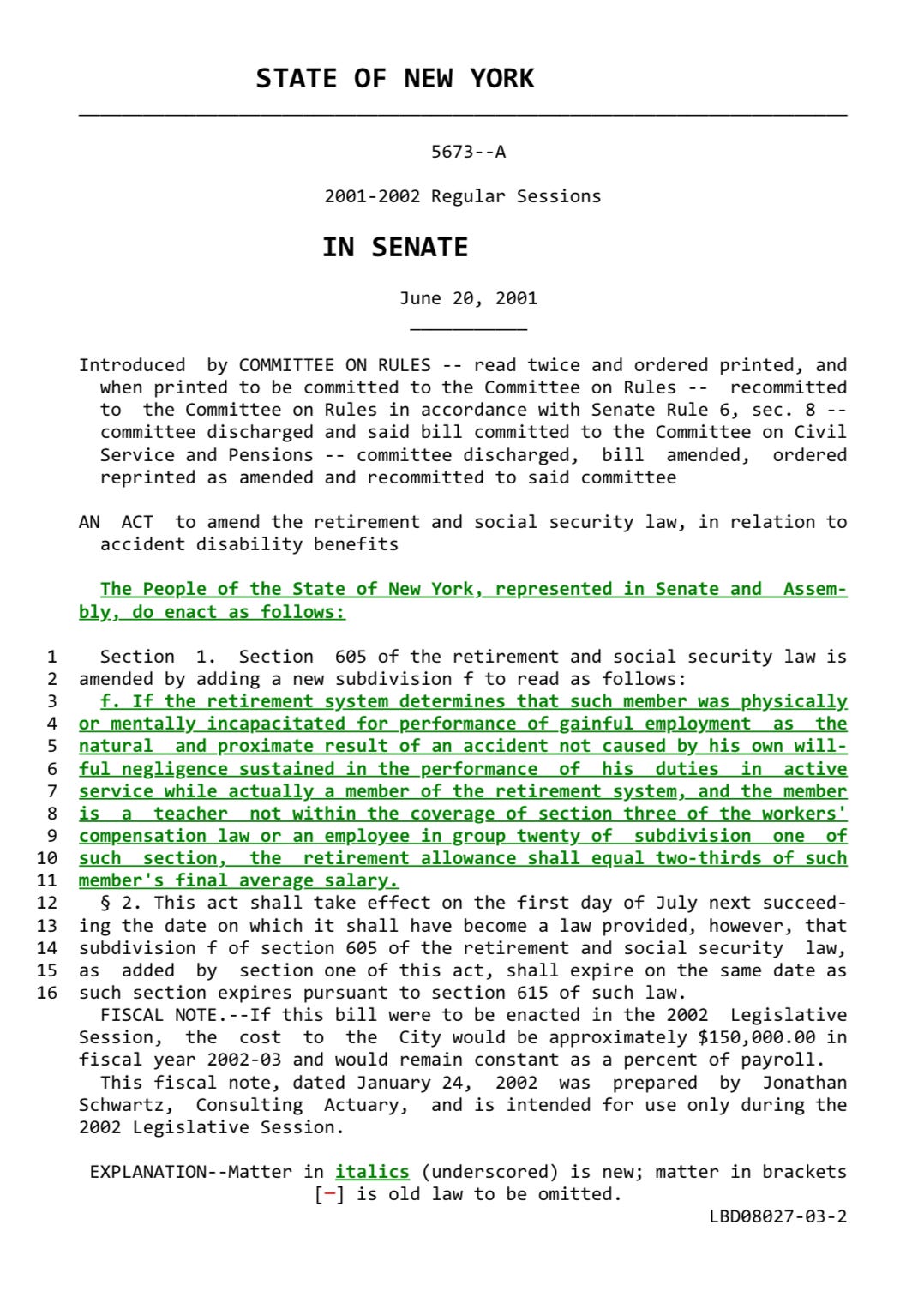
The first dates back to 2002, when the UFT, under then-President Randi Weingarten, lobbied for the very legislation whose language is now at the center of the pension reductions.
The second comes from a 453-page disclosure of internal Teachers’ Retirement System records obtained through a Freedom of Information Law (FOIL) request.
Those records establish that the TRS executive director sent correspondence concerning the pension calculation problem directly to all three UFT teacher trustees on February 5, 2026 — approximately four months before affected retirees began receiving notification.
Those four months happened to coincide with a hotly contested TRS teacher trustee election.
Let that sink in.
The inequity the UFT helped create
In his November 21 Substack article, UFT Unity’s “Respect” for Paraprofessionals, longtime educator and union activist Arthur Goldstein revisits the legislative history behind this catastrophe.
In 2002, the UFT successfully championed legislation that Governor George Pataki signed into law as Chapter 215 of the Laws of 2002.
It was a necessary and worthwhile improvement for teachers.
But what about paraprofessionals?
The legislation did not extend that same protection to them.
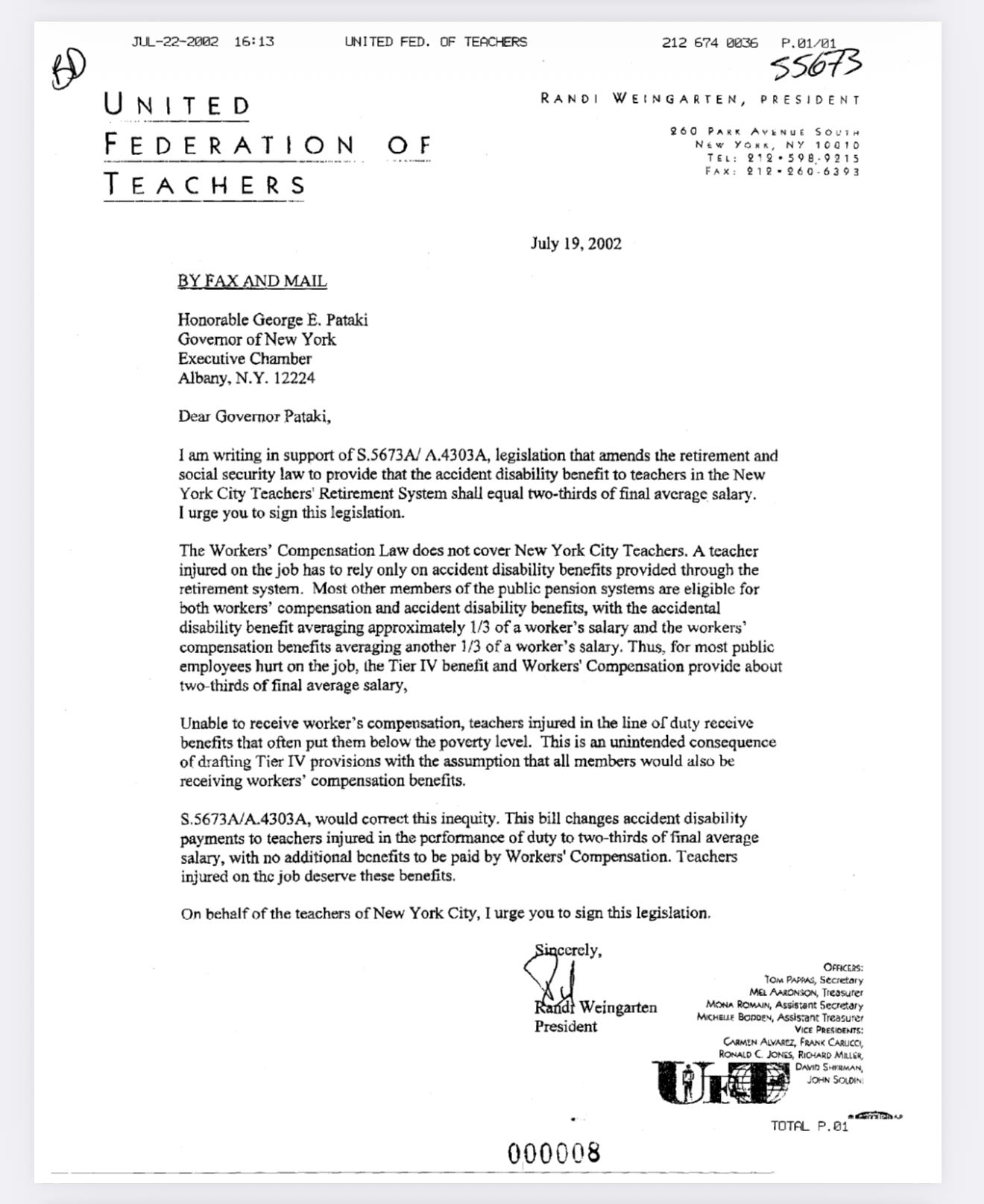
Goldstein points to a letter bearing Randi Weingarten’s signature urging Governor Pataki to approve the legislation. Her advocacy specifically addressed teachers, without securing comparable statutory protections for paraprofessionals.
The legislative justification itself is particularly revealing. It acknowledged that forcing injured teachers to survive on one-third of their final average salary could drive them into poverty.
Apparently, that same concern was not adequately addressed for the considerably lower-paid paraprofessionals represented by the very same union.
The rationale was that employees covered by Workers’ Compensation could supplement their disability pensions with those benefits. But in 2007, New York State imposed duration limits on certain permanent partial disability Workers’ Compensation benefits.
Where was the UFT’s legislative effort to ensure that injured paraprofessionals would not fall through the cracks?
Nearly a quarter-century later, disabled paraprofessionals are paying the price for an inequity their own union helped institutionalize.
The bombshell: They knew in February
In a video statement released today, former TRS teacher trustee David Kazansky draws attention to a disturbing chronology contained in the newly disclosed FOIL records.
The documents raise serious questions about the conduct of the three UFT teacher trustees: Thomas Brown, Victoria Lee and Christina McGrath.
We no longer have to speculate about when correspondence concerning the pension calculation problem reached their inboxes.
We have the emails.
On February 3, during a TRS directors’ meeting, the executive director acknowledged that the retirement system had been calculating accident disability pensions incorrectly since 2001, according to internal correspondence.
Two days later, on February 5, at 2:38 p.m., the TRS executive director forwarded correspondence concerning the pension calculation issue directly to Brown, Lee and McGrath.
The correspondence explicitly identified the one-third pension formula applicable to Workers’ Compensation-eligible job titles.
It also contained this significant revelation:
The Retirements Team has been instructed not to finalize any Accident Disability Retirement case for members holding these titles until further notice.
TRS had already instructed its staff to halt the finalization of affected disability retirement cases.
All three UFT teacher trustees were sent that information.
Internal TRS meeting notes circulated on February 24 further corroborate their notification:
The Trustees were informed of the new rule.
There it is. In black and white.


What happened during the TRS election?
Consider these dates:
January 26: The DOE issues its TRS teacher trustee election memorandum.
February 3: TRS management acknowledges the longstanding pension calculation error.
February 4: David Kazansky announces his candidacy for TRS teacher trustee.
February 5: All three UFT teacher trustees are sent correspondence concerning the calculation problem.
May 13: The TRS teacher trustee election is held.
May 26–June 2: Ballots are counted.
Early June: TRS begins documented outreach to affected retirees.
November 17: The UFT files a notice of claim against TRS.
According to Kazansky, June 2 — the very day ballot counting concluded — was also the date TRS anticipated beginning calls to affected retirees.
Throughout the election campaign, UFT Unity incumbent Tom Brown faced a challenge from Kazansky for a seat on the very board entrusted with safeguarding members’ retirement security.
Yet the pension calculation problem was apparently never publicly disclosed by the incumbent teacher trustees during the campaign.
The records do not establish precisely when each trustee learned the full financial consequences for existing retirees or whether the election influenced the timing of notification.
But the chronology demands an explanation.
Did the trustees inform Michael Mulgrew? Did they object to the delay?
Did they demand that retirees be notified promptly? Did they seek emergency legislative intervention?
And did the election have anything to do with when affected retirees were finally told?
Urgency for brochures, but not for retirees?
On February 23, TRS issued a high-priority email instructing staff to replace its accident disability retirement brochure online “by end of day.” The revised brochure contained a red footnote clarifying the one-third pension formula.
On March 30, TRS ordered another replacement, this time explicitly identifying paraprofessionals as generally covered by Workers’ Compensation.
Both directives came during the TRS election campaign, after all three UFT teacher trustees had been informed of the calculation issue.
Apparently, correcting the pension literature warranted a high-priority email and a same-day deadline. Yet documented direct outreach to affected disabled retirees did not begin until June.
TRS did not need to complete its recalculations to issue a preliminary warning.
They could correct the literature promptly. Why couldn’t they alert the people?
And why didn’t the UFT teacher trustees publicly sound the alarm?
“As you know”
On June 15, the TRS communications director emailed Brown, Lee and McGrath directly.
The opening words?
As you know, TRS has begun outreach to the retirees whose accident disability retirement allowances must be reduced.
The correspondence detailed the pension reductions and recovery of alleged overpayments. It also referred to previous discussions with the trustees.
The email records also show that Christina McGrath requested the original 2002 legislative bill jacket, which she received on June 12. Brown received the same legislative records at his request on July 30.
What remains conspicuously absent from the correspondence cited here is any evidence that the trustees publicly sounded the alarm during the election campaign or demanded that affected retirees receive an immediate warning.
What did they do to protect these members?
The UFT is threatening to sue a pension system its own officers help govern
As reported by Claudia Irizarry Aponte in The City Reporter on November 19, the UFT has filed a notice of claim against the Teachers’ Retirement System.
We welcome any meaningful legal action that protects these retirees.
But consider the extraordinary institutional paradox here.
The chair of the TRS Board of Trustees, Thomas Brown, is also the UFT’s assistant treasurer.
Victoria Lee, another TRS teacher trustee, is the UFT’s treasurer.
Christina McGrath, UFT, occupies the third teacher trustee seat.
All three were sent correspondence concerning the pension calculation issue in February.
The UFT is now preparing to take legal action against a pension system whose governing board includes two of its own financial officers — one of whom chairs that very board — over a statutory provision rooted in legislation the UFT itself championed.
You can’t make this up!
The UFT cannot simply portray itself as an aggrieved outsider coming to the rescue without accounting for the conduct of its own leadership inside the retirement system.
A notice of claim is not absolution.
Nor is there an active lawsuit, just a threat of one.
It took grassroots union organizers to sound the alarm
While affected paraprofessionals were confronting the prospect of losing their financial security, grassroots organizations stepped forward.
The NYC Organization of Public Service Retirees, Fix Retiree Benefits and Fix Para Pay joined forces to bring public attention to the crisis, contact the union and the press, and demand meaningful intervention.
On July 30, the three organizations issued a joint statement titled When the Retirement System Makes the Mistake, Why Are Disabled Retirees Paying the Price?, subsequently published on the Fix Retiree Benefits Substack on August 2.
The coalition called for amending Section 605 of the Retirement and Social Security Law to provide a two-thirds disability pension with an appropriate offset for current Workers’ Compensation payments.
It was a substantive proposal to address both the immediate crisis and the underlying statutory inequity.
These organizations do not have the UFT’s multimillion-dollar resources. They do not command its lobbying apparatus.
What they had was the determination to stand with disabled paraprofessionals when those members desperately needed someone in their corner.
Goldstein reports that it was after these organizations began contacting the union and the press that the response from UFT leadership began to change.
The City Reporter subsequently reported that the UFT had spent several months negotiating with TRS and that the pension system agreed to pause clawbacks until January.
Meanwhile, union organizers, along with Marianne Pizzitola of NYC Retirees, had be vigorously lobbying TRS and the UFT to take action for weeks prior already.
Let’s be clear. The UFT leadership’s intervention is welcome. But it does not permanently resolve the crisis or excuse the preceding months of public silence.
Once again, grassroots organizers and retirees were forced to pressure their own union leadership to defend the interests of union members.
Their contributions to this fight must not be forgotten.
Respect? Show us.
On March 7, the UFT held an event celebrating paraprofessionals and promoting respect for their work — this includes their court-stalled bill passed by City Council for one-time ten thousand dollar work stabilization payments for them, outside of collective bargaining.
There were colorful signs. There were speeches and buttons. There were photographs with politicians.
Yet, by then, the UFT teacher trustees had already been sent correspondence concerning the pension calculation problem a month earlier.
The contradiction is staggering.
While union leadership was publicly campaigning for respect for working paraprofessionals, disabled retired paraprofessionals had yet to receive the documented direct notifications concerning their pension reductions.
Respect would have meant telling them sooner than later.
Respect would have meant fighting for them sooner than later.
The City Reporter documented the plight of Anthony Delgardio, a retired paraprofessional who suffered a concussion and broken bones after being attacked by a student at a Brooklyn special education high school.
His revised monthly pension fell below $1,000. TRS also informed him that it would recover more than $38,000 in alleged overpayments.
He has been forced to contemplate selling his home.
“I can’t even buy a toothbrush right now,” he told the publication.
That is what this pension crisis looks like outside the comfortable offices of union headquarters at 52 Broadway.
And where is Randi Weingarten?
It was under her presidency that the UFT championed the 2002 legislation. It was her signature on the letter urging Governor Pataki to approve it.
And it was paraprofessionals who were left without comparable disability pension protections.
Today, Weingarten heads one of the most politically influential labor organizations in the country — the American Federation of Teachers.
Where is that political muscle for these disabled paraprofessionals?
Where is the letter to Governor Kathy Hochul urging corrective legislation, just as Weingarten wrote to Governor Pataki in 2002?
Why hasn’t she publicly led the fight to rectify the legislative mistake made under her leadership?
If Randi Weingarten could lobby Albany to get this law passed, surely she can atone by helping mobilize organized labor to fix it.
These retirees deserve nothing less.
Make them whole
The UFT must fight to restore these pensions, end the clawbacks and reimburse the retirees for every dollar already withheld.
Mulgrew and the three UFT teacher trustees must publicly account for what they knew, when they knew it and what they did.
And the UFT and AFT must use their political influence to fix the law once and for all.
These retirees cannot afford years of litigation, political finger-pointing or another round of more union promises to paraprofessionals.
Twenty-four years ago, their union helped secure enhanced disability pension protections for teachers but failed to secure comparable protections for paraprofessionals.
This February, its own pension trustees were informed of a calculation problem.
In June, disabled retirees began receiving the devastating news.
Now, 183 people are left wondering how they will survive.
The people who made the pension calculations are not being asked to surrender half their retirement income. The union officials who championed the legislation are not being asked to give back decades of earnings.
The people being asked to sacrifice are the very people who already sacrificed their health in service to New York City’s children.
They did their jobs.
They trusted their retirement system.
They trusted their union.
Make them whole. Fix the law, now. Hold those responsible accountable.
That is what solidarity looks like.
That is what respect looks like.
This is what UNION looks like.
Related:
Paras Need a Living Wage Now, Not To Be Used as Political Props

Last week, the Daily News editorial board got one big thing right about New York City’s paraprofessionals.