


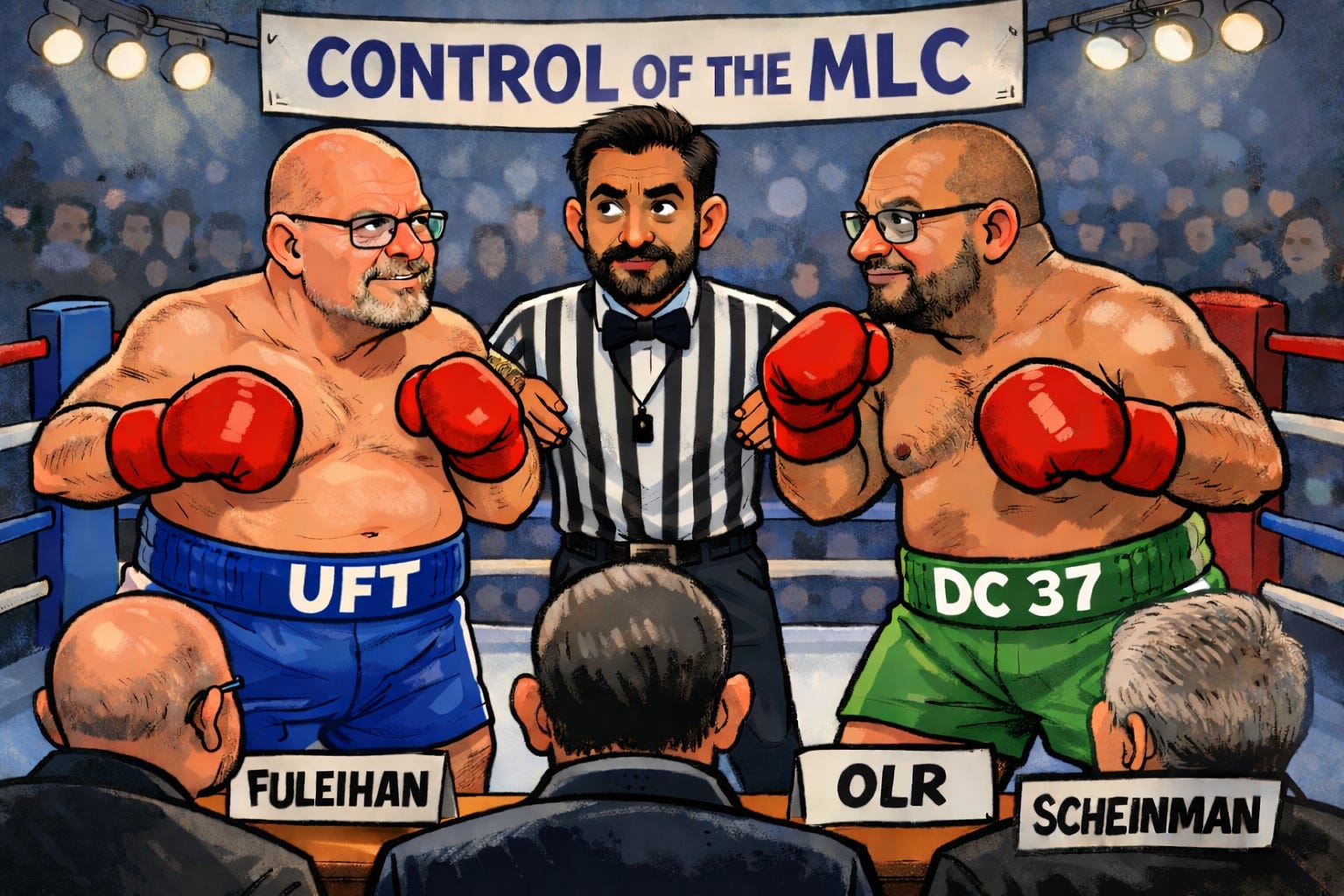
This is no longer a quiet disagreement inside the Municipal Labor Committee. It is a war over who controls its direction—and it has names.
On one side is Henry Garrido, leading District Council 37.
On the other is Michael Mulgrew, president of the United Federation of Teachers.
For years, they moved together. Now they don’t. And because DC 37 and UFT are the two largest unions in the MLC, they also carry the heaviest weighted votes. When aligned, that combined weight has historically been enough to carry decisions and impose direction.
But MLC governance requires a two-thirds majority. And that is where the rupture matters.
With DC 37 and UFT now at odds, neither side can reach the supermajority threshold on its own. Even together, their votes are no longer sufficient without pulling in a critical bloc of smaller unions. The result is paralysis: no easy consensus, no uncontested leadership, and no clear path forward on health policy.
That is not dysfunction. This is a power struggle made structural.
The Breaking Point: When the Cushion Disappeared
For decades, the Health Insurance Stabilization Fund functioned as the MLC’s shock absorber. It covered gaps between projected and actual health-care costs, allowing leadership to promise “savings” without immediately confronting whether those savings were real.
That illusion collapsed when former Comptroller Brad Lander audited the fund and revealed his findings before leaving office in December.
As reported by The City, the audit found that the Stabilization Fund is now entirely insolvent, while billions in long-term liabilities were never clearly disclosed.
Instead of being used solely to stabilize health costs, the fund was repeatedly tapped to plug unrelated budget holes—masking the true cost of labor agreements year after year.
The audit further found:
Basic financial controls were missing
Unpaid liabilities: ≈ $3.1 BILLION
Total taken from HISF overall (City + welfare funds): ≈ $4.3 BILLION
To City: ≈ $2.8B
To Welfare funds: ≈ $1.5B (lump sum) + ≈ $0.69B (recurring)
Bulk transfers from the HISF went to the city and the union welfare funds
Claimed “savings” were often achieved by spending down reserves, not by reducing underlying health-care costs
Once the cushion vanished, there was no buffer left. No room to hide bad assumptions. No way to avoid assigning responsibility.
From that point forward, the central question inside the MLC became unavoidable: who decides direction when the money is gone?
The Minutes Tell the Story
The clearest evidence of the shift is in the most recent DC 37 executive council minutes that have been leaked to The Wire. They read like a union drawing a line.
On welfare fund data, the minutes state plainly:
“MLC members will share Welfare Fund data. DC 37 will do it only after we ensure data is made anonymous.”
That language reflects DC 37’s concern, not any assurance made by insurers.
The same minutes tie Garrido’s posture to a broader warning:
“Executive Director Garrido is concerned with the MLC’s finances, direction, and equity for all members.”
This is not about who “owns” the data.
It is about governance after the MLC’s recent failures.
Lastly, the DC 37 minutes also record a rare break from custom, after two attempts to vote for the next MLC chair resulted in deadlock:
“In the latest vote, neither candidate received the requisite two-thirds vote for MLC Chair. Executive Director Garrido will continue to run and will request a debate with the other candidate.”
In an organization where leadership is typically settled through quiet consensus among the largest unions, calling for a debate signals a refusal to let direction be decided behind among just a few behind closed doors. With DC 37 and UFT holding the heaviest weighted votes but now split, no candidate can reach the two-thirds threshold without persuading smaller unions. A debate forces that reckoning into the open—and makes control of the MLC an explicit, contested question rather than a foregone conclusion.
The Friday the 13th Meeting — Risk Scores, Demographics, and What Was Not Said
That tension hardened at a Friday the 13th MLC meeting convened specifically to discuss plans to share unions’ Welfare Fund data with the City’s insurers, led by UnitedHealthcare and its third-party claims administrator UMR.
If Henry Garrido and DC 37 leadership were concerned about whether data could be considered “anonymous,” that concern was not allayed by the presenters.
There was no representation by UnitedHealthcare or UMR that the data would be anonymized.
Instead, it was made clear—explicitly and implicitly—that member-level and dependent-level data would be used, with each individual assigned a risk score based on specific data tied to real people. Those scores would feed utilization models used to manage care, evaluate claims, fuel delays and denials and shape future cost projections.
That is when Garrido pressed on demographics.
Not as a technical aside, but because demographics are the backbone of risk scoring: age, family composition, medical history, prescription use, and patterns of care. Once those variables are in play, the consequences are predictable.
His concerns are well-founded.
Age alone can drive a risk score. Disability status and pre-existing conditions can too. And race and ethnicity often enter predictive models indirectly—through historical utilization patterns shaped by unequal access to care, systemic bias, and disparities in diagnosis and treatment.
When race, age, or disability function as proxies for cost risk, tiered scoring risks hard-coding existing inequities into benefit administration—raising serious questions about fairness and discrimination, even if no one says those words out loud.
Risk scores do not sit idle. They drive utilization management, inform claims review and power systems that determine:
what gets approved
what gets delayed
what gets denied
and which populations are flagged as “high cost”
Garrido’s skepticism was not ideological. Acting as an interim chair, he was forcing the MLC to confront the reality of what was being approved—without assurances, and with real downstream consequences for members and their families.
That exchange explains why the DC 37 minutes read the way they do. The caution recorded there flowed directly from a meeting where member-specific and dependent-specific data would be used to automate decisions, while unions would later be judged on whether “savings” appeared.
Why Mulgrew Can’t Run For MLC Chair—and Needs a Proxy
Mulgrew still wants the MLC moving fast, tightly aligned with City Hall, and resistant to internal dissent. But he cannot run for chair himself.
His standing across the coalition has been badly damaged—by unilateral decisions, by the fallout from Medicare Advantage, and by what the stabilization fund collapse exposed.
Frankly, he’s highly unpopular among local union leaders.
So UFT needs a stand-in.
That is why it backs Greg Floyd of Teamsters Local 237. Floyd is not the story. He is the vehicle—allowing Mulgrew to shape direction without putting his own name on the ballot.
Where Medicare Advantage Fits—and Where It Doesn’t
Medicare Advantage did not cause this rupture.
It exposed it.
MA was approved under the assumption that the stabilization fund would absorb the risk. When that assumption failed, MA collapsed into lawsuits, injunctions, and political retreat under former mayor Eric Adams.
For DC 37, it became proof that speed without scrutiny produces outcomes unions cannot defend.
History Isn’t a Metaphor—It’s Memory
DC 37 has lived this fight before.
In the early 1970s, Albert Shanker refused to join a DC 37–led MLC under Victor Gotbaum, choosing instead to battle the mayor directly. The dispute escalated when UFT moved to organize DC 37–represented school aides—an effort many viewed as poaching.
The dispute grew so serious that the AFL-CIO intervened, ruled that UFT had violated its anti-raiding provisions, and ordered it to cease.
The lesson stuck: when roles shift and power is unsettled, representation fights follow.
Why Parent Coordinators Matter Now
That history explains why today’s signals are taken seriously.
Since Mayor Mamdani announced changes to the parent coordinator role as part of his agenda to reform mayoral accountability and increase family involvement in our public schools, some DC 37 parent coordinators say they are being quietly encouraged to consider joining UFT. Nothing formal. No announcement. Just conversations.
Parent coordinators are DC 37 members, embedded in schools, and now facing a role redefinition—similar conditions that existed in the 1970s.
For DC 37, that talk is not rumor. It is a warning.
What Comes Next: The War Spreads
Every fight that follows—the PICA PBM RFP, the blame over missed health-care savings, and the race to negotiate first—traces back to the same fact laid bare by Brad Lander’s audit: the stabilization fund was spent down to mask costs, not control them, and once that cushion vanished, the question of who sets direction—and who owns failure—could no longer be avoided.
Healthcare Savings—and Who Gets Blamed
An RFP for a new PBM to handle PICA drugs is coming. If projected savings fall short again, the fight will not be technical. It will be political: which union signed off, and which union warned against it.
Also, there are internal reports that an RFP is in process to renegotiate the city’s Medicare supplemental SeniorCare insurance, this year also.
After Medicare Advantage and the fund collapse, no one wants to be left holding the bag twice.
The Para Check Was a Preview
The failed $10,000 paraprofessional bonus differential check exposed growing fault lines. Other unions, led by DC-37, with lower-paid members balked at giving only one title a substantial differential, and those objections were made known to City Council leadership.
It is a major reason why it did not pass even with a supermajority of council members claiming to support it. None of them would act decisively because of the fractures it would cause.
Labor unity fractured—not against City Hall, but internally.
Who Negotiates First in Next Contract Round —and Sets the Pattern
Both DC 37 and UFT have contracts expiring next year. The fight over who negotiates first—and who sets the pattern—has already begun.
Mulgrew signaled he wants UFT first at the table at the last UFT delegate assembly. But that strategy collides with a commitment by UFT’s parent union, the American Federation of Teachers, to align contract expirations to May 1, 2028.
The AFT commitment to May 1, 2028 reflects language in its resolution explicitly endorsing the UAW’s call to align contract expirations on International Workers’ Day as a way to build toward mass, coordinated national labor action — including the possibility of a general strike — by ensuring unions are not fragmented by staggered contract timelines.
That constraint and pledge complicates things but many don’t think Mulgrew cares.
Mulgrew moved first, in 2014, when De Blasio was elected and took office after years of city unions being without a contract under Bloomberg. It was in 2014 that he made his ill-fated deal for retroactive raises, by dipping into the Stabilization fund for wages, and laid down the groundwork for the slew of healthcare savings givebacks since then. And with newly elected Mayor Mamdani, he has a key player in that 2014 deal — First Deputy Mayor, Dean Fuleihan.
The Bottom Line
This is not a dispute over data. It is not a Medicare Advantage post-mortem.
It is a struggle over who governs the MLC after the money ran out and who the city will hold accountable at the bargaining table because of the failures to achieve “cost savings”.
Garrido is betting that scrutiny, debate, and accountability are unavoidable.
Mulgrew is betting he can still move fast and first.
The minutes show the split. The audit explains the stakes.
Two power brokers have collided.
And the next round of decisions will decide who actually controls the future of the MLC.
Also read:

The MLC rules seem to require that the Chair be from the uniformed services. Aren’t Garrido and Mulgrew ineligible?