


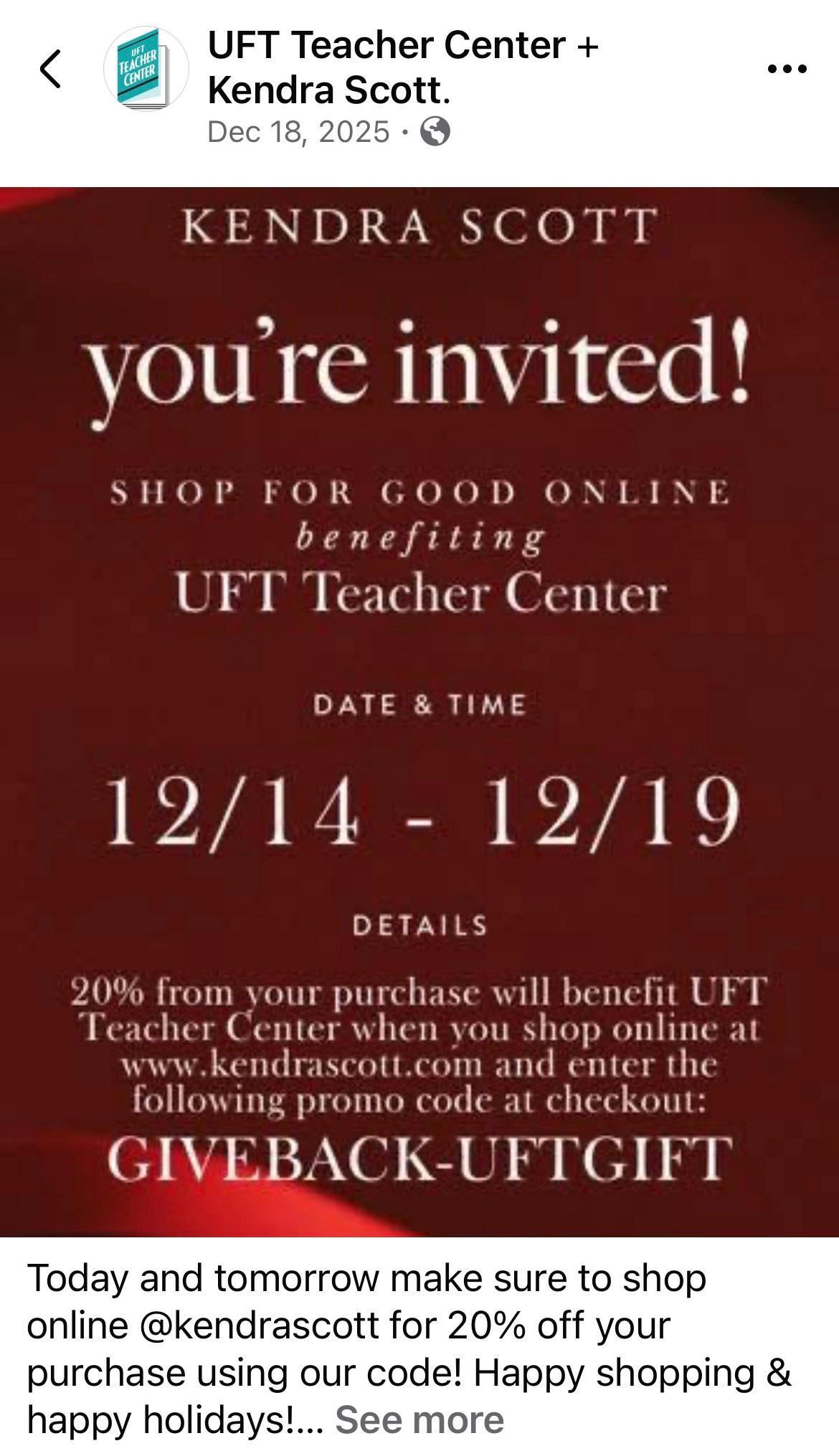
The video is cheerful. Festive, even. A holiday greeting, a thank-you, a warm smile. A union officer, VP of Education Mary Vaccaro, and a senior staffer, Kayla McCormack, stand before the camera and solicit teachers to a shopping event. The message is clear and repeated with enthusiasm: buy jewelry, and 20 percent of every purchase goes back to the union’s Teacher Center.
The company being promoted is Kendra Scott.
The institution lending its voice, credibility, and reach is the United Federation of Teachers.
What’s less visible—but far more consequential—is the trade quietly embedded in the sales pitch.
The Little Yellow Libraries
The multi-year partnership is often justified by pointing to “little yellow libraries”: brightly branded classroom libraries donated to a small number of New York City public schools. The libraries are real. Teachers and students benefit from them. No one disputes that.
But philanthropy is defined not just by what is given—but by what is demanded in return.
Here, the exchange is unmistakable. In return for a limited number of highly visible, brand-forward libraries, a global jewelry retailer gains something far more valuable: direct, repeated access to one of the largest labor unions in the country, a union whose membership is more than 75 percent women—precisely the demographic the brand is built to reach.
This is not charity in the traditional sense. It is cause marketing, routed through a labor organization.
The video makes that plain. A union officer thanks Kendra Scott for its work with New York City public schools. A senior union staffer—introducing herself as the director of the Teacher Center—welcomes viewers to “our Kendra Scott event” and explains the incentive: shop, and the union benefits. The union is not a passive recipient of a donation. It is an active sales partner.
That distinction matters.
True philanthropy does not require a shopping cart. It does not hinge on consumer conversion rates. It does not depend on union officers and staff becoming de facto brand ambassadors. If the goal were simply to support students and libraries, the libraries would exist independent of retail events, discount codes, and promotional videos.
Instead, the model works the other way around. A handful of schools receive mini-libraries. Tens of thousands of educators are encouraged—by their own union—to buy jewelry. The upside for students is limited and localized. The upside for the corporation is scalable and ongoing.

The Real Ethical Problem: Kendra Scott’s Poor Labor Record
And there is another layer the cheerful tone of the video never acknowledges: labor.
Independent ethical-fashion reviewers such as Good On You assign Kendra Scott a “Not Good Enough” overall rating—including a 2 out of 5 for workers’ rights—based on how much the brand discloses about its supply chain and labor safeguards.
Good On You notes that the company’s products are sourced through “final stage of production from countries with high risk of labour abuse,” and that there is no public evidence it ensures living wages, financial security for suppliers, or diversity and inclusion in its supply chain.
There is no public evidence that Kendra Scott’s supply chain involves proven sweatshops — while the risk is very high based on where supplies are sourced.
Kendra Scott is not unionized, either.
Yet the absence of transparency and publicly verifiable worker protections is exactly the kind of risk traditional labor solidarity and ethical sourcing standards are meant to avoid. A teachers’ union, of all institutions, should recognize the difference between absence of evidence and evidence of absence.
Historically, unions draw bright lines between worker advocacy and corporate promotion precisely to avoid this kind of contradiction.
A union’s power comes from trust: trust that its leaders will put workers first, trust that its voice will not be rented out, trust that solidarity does not stop at national borders or at the checkout counter.
The little yellow libraries complicate that trust. They are good, visible, emotionally resonant. They make criticism almost uncomfortable. Who wants to argue against books for children?
But when classroom libraries become the justification for turning a union into a sales channel—when profit-seeking access to a women-majority workforce is the unspoken price of generosity—the question isn’t whether the libraries help. They do.
The question is whether they are being used as leverage.
A labor union should not have to ask its members to shop at repeated events in order to uphold its values. Nor under the cover of promoting schools or the union. And it should not need a jewelry brand’s marketing budget to support literacy.
When a union officer and staffer stand before the camera and sell a retail event, the issue is no longer about holiday cheer or fundraising creativity. It is about boundaries—and who benefits when those boundaries dissolve.
Libraries should be gifts, not profit-making gateways.
Solidarity should not be conditional on consumer consumption.
Our union leadership is struggling to mobilize our union to attend union rallies and yet they put their energy into this? What has happened to our union values?
More Questions Union Leadership Should Answer
What criteria were used to choose which schools received yellow libraries, and why were teachers asked to shop as part of that exchange?
Kendra Scott’s public disclosures describe ethical intentions and policies, but independent reviewers note the absence of publicly verifiable evidence on wages, worker protections, and factory-level conditions.
What steps, if any, did the union take to assess whether those stated intentions reflect the lived reality of the non-union workers who actually manufacture these products before promoting the brand to its members?
Did the union conduct any supply-chain or labor-rights due diligence on Kendra Scott before promoting the shopping event to tens of thousands of educators?
Why is a labor union endorsing a global consumer brand whose workers are overwhelmingly non-union and whose publicly assessed workers’ rights record is rated “Not Good Enough” by independent ethical reviewers?
Is there a written policy governing when and how union officers can use official channels to promote private corporate partners? If so, why was it applied here? If not, why not?
How does the union reconcile promoting consumer spending with its core mission to advocate for fair wages, safe conditions, and worker dignity—especially when Good On You and others note a lack of evidence Kendra Scott ensures living wages or supplier financial security?
Will the union publicly disclose any evaluations it performed regarding Kendra Scott’s labor practices and supply-chain transparency?
What safeguards are in place to ensure that no union officer or staff member receives any personal benefit—financial, professional, or reputational—from promoting or participating in corporate partnerships like the Kendra Scott shopping events?
Is it appropriate for a primarily state-funded Teacher Center to participate in retail shopping promotions, and what assurances exist that such activities comply with the program’s grant requirements and intended public purpose?
If a Kendra Scott shopping event promised a 20% giveback to the UFT Teacher Center, in which fiscal year was that apparent fundraising revenue received, and where is it reported on the most recent Form 990s for the UFT non-profit that it falls under? If it was restricted, why does the Foundation report zero net assets with donor restrictions?
Incredible! Years ago I was connected with a gentleman who was giving books to needy schools…free, no strings or money attached. He sent us something like 500 books. They were supposed to be for my classroom which was Pre-K. Not all the book were pre-k level so I shared them with other teachers who were thrilled to get books for their classrooms. I thanked him and told him what I did. He was thrilled. He didn’t ask for a dime or advertise his philanthropy.
The Union seems to be loving dealing with nonunion companies as they did when a deal with UHC was made. But to ask teachers to spend money on jewelry to get a library? Why not just buy books for your classroom as I and other teachers did/do through Teachers Choice or through a tax deductiion or just because? There are many philanthropic sources out there that are willing to help children. Why isn’t the Union seeking out those sources?
Thank you for exposing this highway robbery.
any surprise whatsoever that the powers that be in our union would do something like this when it treats members of the union who are not unity the way they do? when they fired union workers to hire a non-unionized company to answer phones and deal with members calling? when they fire people they don't like on whim or because they feel like it, one of the very things that unions were started to prevent? one only has to wonder what they are getting personally to arrange such a deal. it can't just be for a few libraries at a few schools.