


The paraprofessional “Respect Check” bill is back. But it is not the same para bill.
This week, the United Federation of Teachers revived its legislative push to deliver a $10,000 annual payment to New York City paraprofessionals. Branded as a “RESPECT Check,” the proposal is being framed as long overdue relief for a workforce that earns barely above $31,000 at entry level in one of the most expensive cities in America.
No one serious disputes the crisis. Paraprofessional shortages are real. Turnover is high. Many paras work second jobs to survive. Students with disabilities rely on them daily. Retention is not a theoretical workforce metric — it is a structural vulnerability in the school system.
And the shortage centers around the reality that paras need a living wage.
Two years ago, a dissident slate of rank and file paras, called Fix Para Pay, won the paraprofessional chapter election by a 75% margin by drumbeating this very message.
Fix Para Pay’s success worried the union leadership Unity-UFT caucus so much that they decided that proposing a para “Respect Check” bill in the middle of the 2025 general union officer elections would help them curry favor with paras once again.
But once you move beyond the Respect Check branding, caucus politics, electioneering and read Intro 0692-2026 carefully, a more complicated story emerges.
Is this relief now, respect later?
Or is relief being positioned as a substitute for respect?
What the New Bill Actually Creates
Intro 0692-2026 establishes what it explicitly defines as a “non-pensionable lump sum payment of $10,000” per year for eligible paraprofessionals. The payment is to be issued no later than August 1 following the school year. It does not amend the DOE salary schedule. It does not increase base pay. It does not alter longevity steps. It does not count toward retirement calculations.
The bill calls these payments “workforce stabilization.”
And it calls them temporary.
The statute states that once the city signs a collective bargaining agreement providing an increase in “total annual compensation” equal to or greater than the stabilization payments, the law is deemed repealed.
Not phased out.
Repealed.
The title itself includes the phrase “providing for the repeal thereof.” The exit ramp is written directly into the structure.
But a bigger fact remains. Even if this is passed into law, it could be repealed at any moment at the whims of political actors in City Council and City Hall.
The union calls this respect.
The bill calls it stabilization.
Stabilization is an emergency tool — not structural permanence.
A Hard Pivot From Last Year
The contrast with last year’s proposal is impossible to ignore.
Intro 1261-2025 — sponsored by Keith Powers and backed by 47 Council co-sponsors — was framed as a structural correction, a “para pay index” tied to the widening gap between paraprofessional starting salaries and the highest principal salaries. The union publicly described it as fluctuating above a $10,000 floor, with projected growth over time. Reporting at the time suggested it could begin around $10,800 and rise toward $12,000 in later years.
That earlier model was not pensionable either. It was not collectively bargained. But it was presented as dynamic — responsive to widening inequities rather than frozen at a flat number.
This year’s bill drops the index entirely. There is no principal linkage. No escalator. No formula responding to differential growth. What remains is a fixed $10,000 payment framed as temporary stabilization.
If last year’s pitch was “we fix the gap,” this year’s version is “we issue a relief check.”
That is not a cosmetic change. It is a strategic downgrade. And none of this has been explained to members.
The $450 Million ‘Epic Fail’ Moment
This is not the first time paraprofessional wages were at a crossroads.
Nearly half a billion dollars represented rare fiscal flexibility. Instead of using that moment to permanently lift the lowest-paid title in the system, leadership chose equal distribution across the membership.
The result was short-term relief — but no structural shift in para salary schedules, no pensionable correction, and no narrowing of long-term pay gaps.
In a union that touts and teaches equity – helping those most vulnerable and in need – it failed to practice it.
That was not an inevitability. It was a policy decision.
Now leadership argues legislation is the only path to immediate relief. Members remember the earlier forks in the road.
The Internal Fight Before This Bill
The strategic pivot toward legislation did not happen quietly.
A member-driven resolution called for a comprehensive collective bargaining plan to win a living wage for paraprofessionals — complete with timelines and measurable objectives. It would have required the union to map out escalation before the next contract.
Instead, the key language was stripped.
At Executive Board and Delegate Assembly meetings, the Unity-aligned para chapter leader, Priscilla Castro, argued against tying the union’s hands at the bargaining table. Rather than centering living wages, discussion shifted toward professional development, CTLE credits, and procedural items. Earlier remarks by Castro at the UFT executive board suggesting that NYC paraprofessionals were “better off” than those in other states reinforced the perception that expectations were being managed downward rather than lifted.
The binding elements of the bargaining plan were removed from the resolution. The legislative strategy advanced.
A year later, a plan was devised by the leadership’s “three men in a room” to use our union’s COPE dollars in a local legislative fix for para pay while never consulting paraprofessionals on exploring a range of solutions.
The shift placed compensation reform in City Hall rather than at the negotiating table.
It compensates and relies heavily on lobbyists rather than engage in the work of grassroots planning and organizing with paras.
The Political Optics: Mulgrew, Menin, and the Money

For this bill to pass this time around, they will need a cooperative City Council speaker.
The proximity between Michael Mulgrew and City Council Speaker Julie Menin is not merely rhetorical. It’s closer than we may think.
They say politics creates “strange bedfellows” and, no doubt, the UFT leadership has definitely been courting Menin.
Campaign finance disclosures show that “United For NYC’s Future (2025),” an independent expenditure entity connected to UFT leadership, reported $1.75 million in total contributions and $1.65 million in spending. Of that total, $210,219 was spent in support of Menin’s City Council campaign.
That figure represents independent expenditure support — not a direct payment to Menin — but it places her among the most heavily supported candidates in that filing. Second only to our union’s COPE monies given to former UFT political operative Dermott Smyth’s failed city council run.
That the UFT spent that amount of money when Menin did not face any stiff competition and won her race handily, says something.
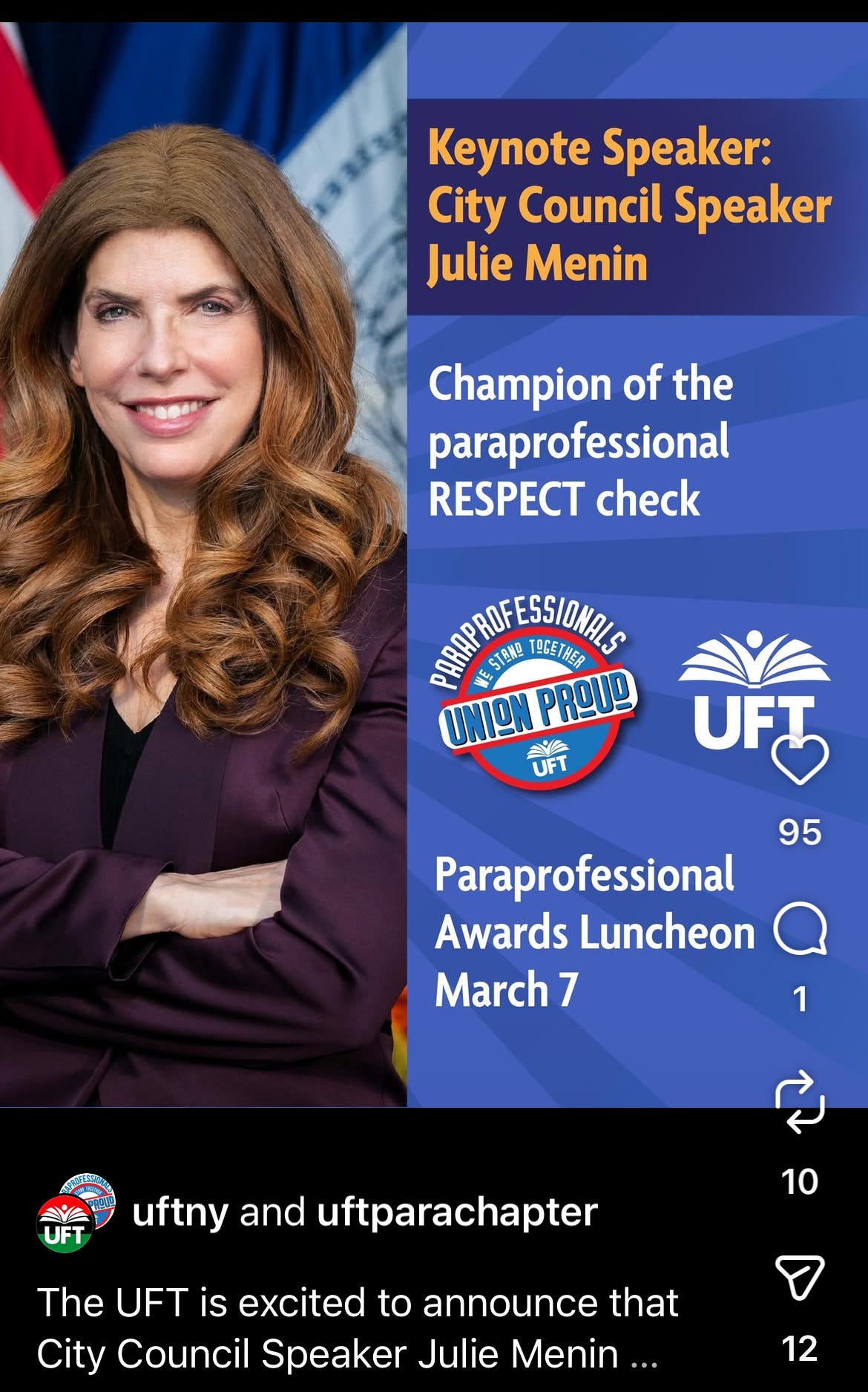
Now she is publicly branded by the union as the “Champion of the Paraprofessional RESPECT Check.” She is headlining this year’s UFT para awards luncheon.
More importantly, she presides as Speaker over the revived legislation.
Last year’s indexed bill died because then-Speaker Adrienne Adams blocked it at the end of session. Leadership determines what moves.
This time, the Speaker who received over $210,000 in independent expenditure support from a UFT-aligned entity is overseeing the revived effort.
That does not prove causation.
But it establishes political alignment.
And alignment matters when a bill estimated to cost roughly $260 million annually moves through a Council facing a projected $7 billion budget gap and active discussions about reserve withdrawals.
But honeymoons are short lived. Things can change quickly when the bills start rolling in. And finding close to $300 million a year to pay for this para bill at a time when the city faces a budget crisis may ruin the mood of City Hall and the Menin-Mulgrew relationship.
Other Unions Are Watching — And So Are School Aides, Cafeteria Workers, & EMTs
The ripple effects extend beyond paraprofessionals.
Other union leaders are not happy with this bill as written. Mulgrew has told members as much.
DC 37, which represents low-paid school aides and cafeteria workers, has signaled concern about precedent. A legislative supplement for one title outside collective bargaining disrupts the coordinated framework inside the Municipal Labor Committee.
And the parity pressure is not theoretical.
EMT workers are currently asking the City Council for pay parity with their fellow FDNY colleagues. They argue they perform emergency response work alongside firefighters, operate in the same high-risk conditions, yet are paid significantly less under separate union structures.
If City Council becomes a venue for targeted wage correction, pattern bargaining begins to fracture. Every low-paid title — aides, cafeteria workers, clerical staff, EMTs — will have a legislative blueprint.
This bill is not just a para bill.
It is a precedent.
The Fiscal Headwinds
Even if the moral case is compelling, the fiscal climate is unforgiving.
Based on the mayor’s public budget outline reported earlier this year, the proposed reserve drawdowns to help cover the deficit were:
$980 million from the Rainy Day Fund
$229 million from the Retiree Health Benefits Trust
That totals $1.209 billion proposed from reserve funds to cover the budget shortfalls this fiscal year.
As it stands, the preliminary budget leaves out funding for several previously supported school programs, including restorative justice initiatives, expanded mental health services, and certain student support programs such as social workers and internship pathways. Without restoration in the final budget, schools could lose critical wraparound services that support vulnerable students, school climate, and dropout prevention efforts.
Other programs and services citywide will see cuts or elimination while increases to homeowner’s property taxes are also being proposed.
Meanwhile, estimates place the para bill stabilization payments at roughly $260 to $300 million annually.
The union’s FAQ argues the money would come from the City’s general funds and notes that the city previously “found” billions in additional resources. That argument may have sounded persuasive in a surplus cycle.
In the deficit cycle we are currently in, defined by reserve withdrawals and austerity planning based on a $7 billion budget gap, it sounds very unrealistic.
Contractual raises are binding obligations.
Legislative supplements are political and economic line items.
That distinction matters when budgets tighten.
The Pledge Campaign: Commitment — To What?
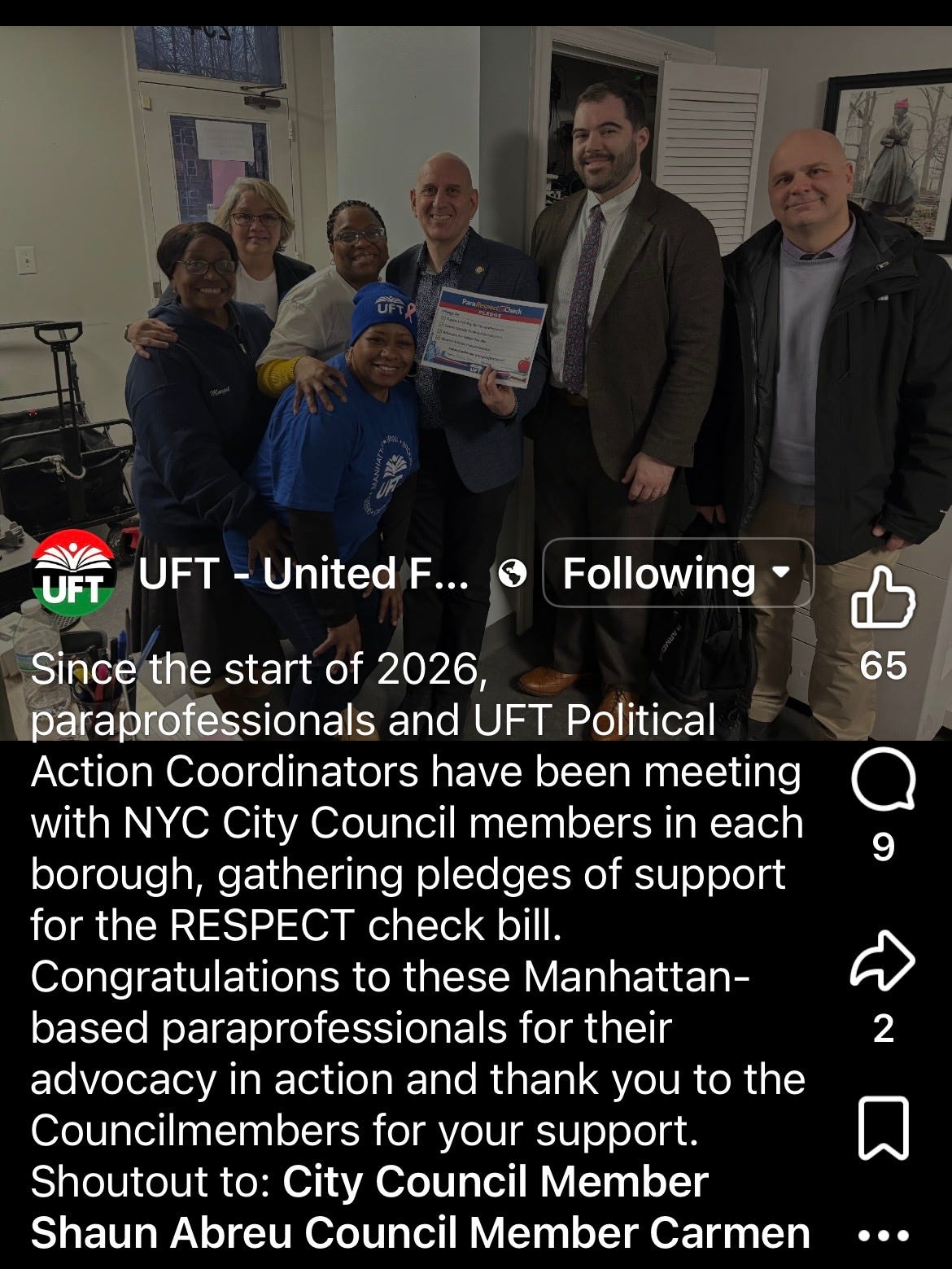
Alongside the revived bill, UFT leadership, to their credit, has rolled out a coordinated push bringing paraprofessionals face to face with City Council members. Social media posts celebrate “pledges of support” secured borough by borough. The optics are strong: paras in union gear, council members smiling, pledge cards in hand.
But what are they actually signing?
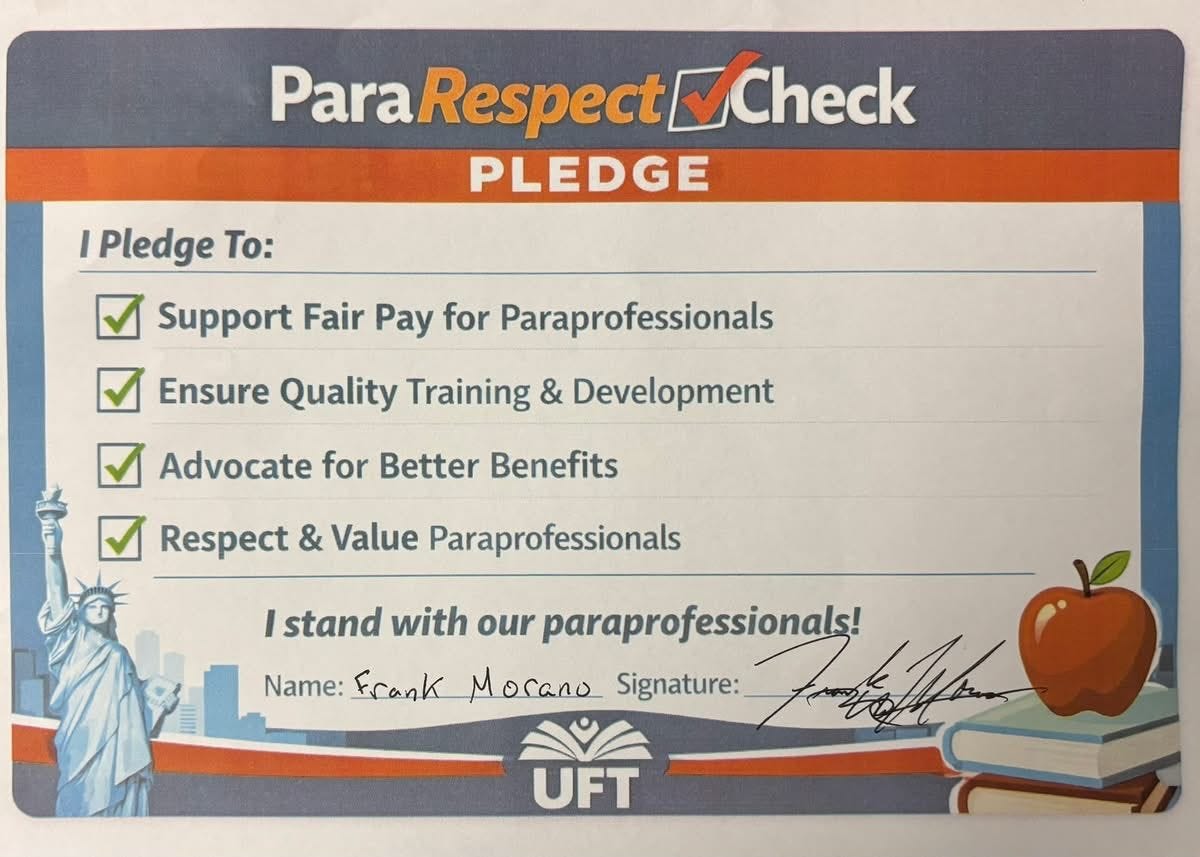
The certificate reads “Para Respect Check Pledge” and includes four commitments:
Support Fair Pay for Paraprofessionals
Ensure Quality Training & Development
Advocate for Better Benefits
Respect & Value Paraprofessionals
At the bottom: “I stand with our paraprofessionals!”
It is politically airtight. No council member is going to oppose “fair pay.” No one is against “respect.” In a city where paraprofessionals start at barely $31,000, support for fairness is the easiest vote in the room.
But the pledge does not reference the para bill, Intro 0692-2026.
It does not mention a $10,000 non-pensionable stabilization payment.
It does not commit to approving a roughly $260-300 million recurring expense.
It does not bind anyone to vote yes in the middle of a projected $7 billion budget gap.
The language is intentionally aspirational and ambiguous, not legislative.
There is a difference between signing a values statement and voting for a specific fiscal obligation. Council members represent districts with competing demands — housing, sanitation, youth services, public safety — all within a tightening budget.
So when the union announces “commitments secured,” the real question is not whether council members support fair pay in principle.
The question is whether they are prepared to fund this bill, at this cost, under these fiscal conditions.
Those are not the same commitment.
Relief Now — But What About Respect?
Nobody serious denies paraprofessionals need immediate relief. Even critics acknowledge that $10,000 would ease real burdens in this affordability crisis we are facing.
But an investigative reading of this legislation shows something else is real:
This is not the structural solution that was sold last year.
Last year’s model was pitched as a para pay index tied to widening principal differentials, designed to rise above a $10,000 floor.
This year’s model is a fixed $10,000 payment labeled temporary, explicitly non-pensionable, and written into law as something that will repeal itself once certain compensation thresholds are met.
Add the earlier $450 million contract decision. Add the dilution of a bargaining roadmap. Add the political alignment. Add the fiscal uncertainty and precedent implications.
Add that none of this is guaranteed.
A pattern emerges.
Relief is promised.
Union power is deferred.
The union leadership can call that respect.
But the bill calls it stabilization.
And stabilization is not permanence.
The real question is not whether paraprofessionals deserve $10,000 more.
It is whether stabilization becomes the ceiling — or whether respect still means structural, pensionable, collectively bargained pay.
The Bottom Line: Mulgrew and his Unity caucus, time and time again have DISRESPECTFULLY failed for decades to deliver a living wage for paraprofessionals —only delivering more and more excuses and empty promises.
And kicking the can down the road again is not RESPECT, either.
Vamos a ver.
Regarding the Fix Para Pay crisis: It is the responsibility of the UFT to negotiate wages and working conditions for its members. ..not to turn paraprofessionals into supplicants begging city government for handouts. Real RESPECT is when the union advocates for all of its members. Gail Lindenberg, RTC
What a pathetic joke. Mulgrew & crew gots to go!